
California Makes History: $1 Billion in HVIP Vouchers Paid
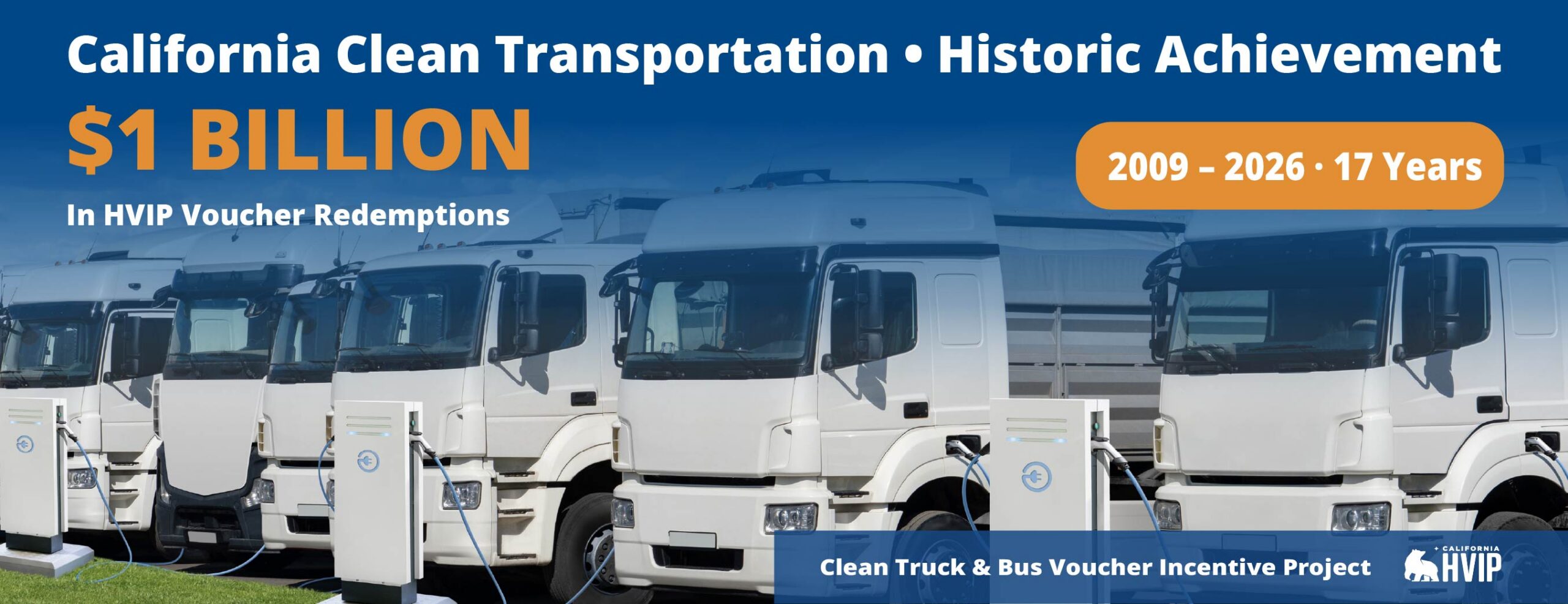
California HVIP Surpasses $1 Billion in Commercial Medium- and Heavy-Duty Clean Transportation Vouchers
We're thrilled to announce a historic milestone: California's Clean Truck and Bus Voucher Incentive Project (HVIP) has officially surpassed $1 BILLION in voucher redemptions, a landmark achievement in our collective commitment to clean transportation.
This is a joint achievement between the California Air Resources Board (CARB), funders of the project, and CALSTART, administrators of the California HVIP Project. Launched in 2009 by CARB, and part of the California Climate Investments—which uses billions of Cap-and-Invest revenue to support clean transportation—HVIP has become one of the most reputable clean transportation incentive initiatives in the United States.
That billion isn't just a number — it represents real change on California's roads. Here’s a look at the impact we’ve built together:
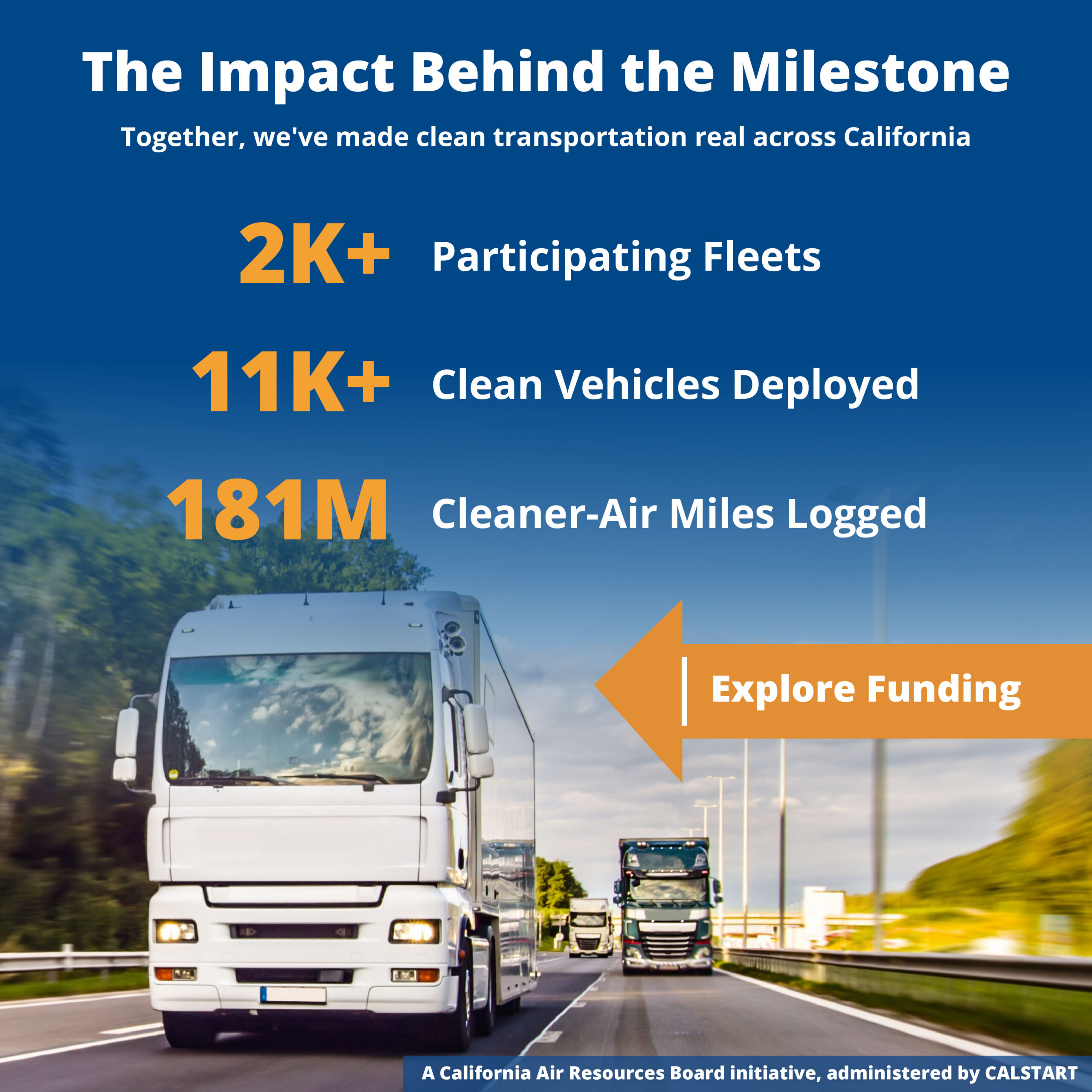
- Supported more than 2,000 participating fleets in their transition to cleaner technology;
- Deployed over 11,000 medium- and heavy-duty clean vehicles across California;
- Logged 180+ million cleaner-air miles; and
- Reduced nearly 1.5 metric tons of CO₂ equivalent emissions and over 2,200 tons of NOx.
Read the full press release
Your participation has been instrumental in reaching this milestone. Together, we're proving that zero-emission transportation is not only possible, but it's sustaining real market growth, with 38 OEMs and over 150 vehicle models now available through HVIP.
HVIP remains committed to expanding access and affordability for fleets of all sizes. Whether you're just beginning your electrification journey or looking to grow your zero-emission fleet, we're here to support you every step of the way.
HVIP funding is available and remains open. Fleets and dealers are encouraged to submit voucher requests now! Explore funding opportunities at californiahvip.org/funding or find eligible vehicles in the vehicle catalog.
Contact Cal Fleet Advisor for personalized support.
Thank you for driving California’s clean transportation future.
CALSTART HVIP Team

HVIP Transit Set-Aside Waitlist
This post was updated on June 12, 2025 (scroll to down for update).
As of 4/23/2025 at 5:50pm PT, the Transit Set-Aside is fully subscribed. A waitlist will accept additional voucher request submissions up to 10% of the total Transit Set-Aside allocation ($13.5 million). Vouchers submitted after 4/23/2025 at 5:50pm PT will be added to the waitlist.
If existing transit set-aside vouchers get cancelled, the waitlist will be used to fund additional vouchers using the cancelled voucher funding.
Waitlists reroute funds from cancelled vehicle orders to potential voucher requests that are ready to be processed through the Clean Truck and Bus Voucher Incentive Project (HVIP) standard review and redemption process. The waitlist does not guarantee funding for submitted voucher requests. Requests on the waitlist are processed on a first come, first served basis.
About the Transit Set-Aside: To continue the transition to zero-emission bus fleets, the HVIP Transit Set-Aside funds transit agencies subject to the Innovative Clean Transit (ICT) regulation that are purchasing HVIP-eligible transit buses in early or in excess of regulatory targets. Any transit agency subject to the ICT regulation must be in compliance with all regulatory targets and reporting to redeem an HVIP voucher. Voucher requests submitted to the waitlist must be eligible for the Transit Set-Aside.
Dealers and purchasers will be notified if their voucher request is placed on the waitlist for the Transit Set-Aside.
**Be Ready When New Funding Opens! ** New HVIP funding across categories is expected to be released in the coming months. Join our priority notification list to be among the first to know when new funding becomes available.
For funding availability, please visit our funding page.
UPDATE: As of 6/3/25, the waitlist for the Transit Set-Aside is CLOSED. Waitlisted voucher requests may be removed from the waitlist and reviewed if funding becomes available, on a first-come, first served basis.
If you have any questions, please contact [email protected].
HVIP Hits Record Growth as Zero-Emission Truck and Bus Market Expands
California’s Clean Truck and Bus Voucher Incentive Project (HVIP) experiences an unprecedented surge with voucher redemptions soaring 177% from 2023 to 2024, with early 2025 data showing this upward trend continuing as fleet electrification accelerates across California.
The move to sustainable transportation is picking up speed on California’s roads. In February 2025 alone, more than 200 HVIP-funded zero-emission trucks and buses were deployed—with $31+ million in redeemed vouchers.
HVIP provides point-of-sale discounts to make zero-emission vehicles (ZEVs) more affordable and accessible for California fleets and businesses. Over the last 15 years, HVIP has provided $754 million to help 2,000+ participating fleets purchase and place into service more than 10,000 medium- and heavy-duty clean trucks and buses at a lower cost. These vehicles—ranging from delivery vans to school buses to freight trucks—have logged over 340 million cleaner-air miles, significantly slashing carbon emissions across the state.
Momentum is building as HVIP promotes accessibility and affordability for California public agencies and small businesses, which make up approximately 81% of ZEV orders. To help meet market demand, 6,000 HVIP-funded ZEVs are currently ordered and in production. In 2024, school buses were the most requested vehicle, followed by vans and straight trucks.
The pace of adoption is faster than ever. HVIP continues to expand its portfolio by adding more manufacturers, dealers, and 150+ state-of-the-art vehicles while driving widespread zero-emission fleet adoption. CALSTART’s latest Zeroing in on Zero-Emission Trucks report and Zeroing in on Zero-Emission Buses report show more than 6,000 zero-emission truck deployments (roughly 15% of nationwide deployments) and more than 2,200 full-size zero-emission transit bus adoptions (roughly 31% of nationwide adoptions) in California as of mid-2024, establishing the state as a clean transportation hub.
"It's exciting to see significant growth across HVIP this past year through increased zero-emission truck and bus deployments," said Tom Brotherton, Senior Director, HVIP and CORE, CALSTART. "This rising demand confirms our continued progress toward zero-emission transportation and our sustained investment in making it more accessible. We remain committed to expanding zero-emission technology for diverse fleets in order to reduce carbon emissions and drive innovation across California.”
With demand at an all-time high, several HVIP funding categories have reached capacity, but qualifying fleets can still access funding through the transit set-aside and Innovative Small e-Fleets (ISEF) program, a dedicated set-aside for small fleets with fewer than 20 trucks and less than $15 million in revenue. Eligible fleets are encouraged to find a dealer and apply while funds remain available.
To explore funding opportunities and vehicle options, visit californiahvip.org/funding, or sign up to stay informed about HVIP funding alerts and program updates.
HVIP is administered by CALSTART on behalf of the California Air Resources Board.
Privacy Policy Update
February 21, 2025
We value your privacy.
We’ve updated our Privacy Policy to provide greater clarity on how we process your personal data. Our commitment to transparency means keeping you informed about how we use and protect your information. The policy has been expanded to include our complete CALSTART Privacy Policy, making it easier for you to find all privacy-related information in one place.
These updates, which took effect February 7, 2025, include important changes to where legal disputes will be settled.
At CALSTART, protecting your data remains one of our highest priorities. Thank you for partnering with us to change transportation for good and for trusting us with your information.
Partial Tax Exemption for Zero-Emission Technology Transit Buses Extended
The partial sales and use tax exemption for eligible purchases and leases of zero-emission technology buses was scheduled to expire on December 31, 2023, and has been extended through December 31, 2025.
Vehicles eligible for the partial sales and use tax exemption must also be HVIP eligible vehicles. The partial tax exemption applies whether or not HVIP funding was used to purchase or lease the transit bus.
See Industry Topics → Specific Exemptions
Policy Changes for FY24-25 and Closure of Standard HVIP and Drayage Set-Aside
November 26, 2024
Update December 19, 2024: the Drayage Set-Aside is also now closed. See www.californiahvip.org/funding for ongoing updates on available funds.
The Clean Truck and Bus Voucher Incentive Project (known as HVIP) is no longer accepting requests for Standard funds. Requests can still be submitted for the Drayage Truck Set-Aside, the Transit Set-Aside, and the Innovative Small E-Fleets (ISEF) project for fleets that qualify.
HVIP has funded more than 14,000 clean-technology vehicles, providing $1.5 billion to public and private fleets since 2010. In 2024 alone, 81% of all HVIP vouchers supported public agencies and small businesses.
The Public School Bus Set-Aside closed at the end of 2023, funding from the Ports of Los Angeles and Long Beach Drayage closed in October 2024,and the Zero Emission School Bus and Infrastructure (ZESBI) project closed November 22. Available incentives are updated regularly at www.californiahvip.org/funding.
On November 21, the California Air Resources Board (CARB) approved the Fiscal Year (FY) 2024-2025 Funding Plan for Clean Transportation Incentives, which includes HVIP policy changes and a $14.97 million allocation for ISEF.
The Funding Plan outlines the following adopted policy changes for HVIP:
Effective November 22, 2024:
Base voucher amount doubling for small fleets: The +100% base adjustment for public and nonprofit fleets size 20 and smaller, and for private fleets size 20 and smaller with less than $15 million annual revenue, continues to be available in Standard HVIP (when the program is open), the Drayage Truck Set-Aside, and the Public Transit Set-Aside for any HVIP-eligible vehicles. However starting 11/22/24, the doubling is only available for a maximum of 5 vouchers (all-time total, not annually). This limit is not retroactive, meaning that small fleets with existing doubled vouchers before 11/22/24 are permitted up to 5 additional doubled vouchers. Vouchers cannot be doubled in combination with the +65% voucher enhancement for school buses.
Voucher amounts for truck conversions: For vouchers requested on or after 11/22/24, incentive amounts for truck conversions have been increased to 75% of a standard new truck voucher from 50% of a new truck voucher. These changes are reflected at www.californiahvip.org/vehiclecatalog.
Effective January 1, 2025:
Fleet size exclusion: Private fleets size 50 and larger, based on the fleet size definition found in the FY23-24 Implementation Manual, and in FAQ #5 at www.californiahvip.org/about, will be ineligible to place new voucher requests starting 1/1/25. This change does not affect existing vouchers requested before 1/1/25. Public entities, California Native American Tribal governments, and nonprofit organizations with 501(c)(3) status will not be subject to the fleet size limit. Additionally, entities purchasing new-to-market technologies, such as fuel cell vehicles, will not be subject to the fleet size limits until the technology has achieved a higher degree of market penetration, meaning fleets of any size can continue to purchase fuel cell vehicles through HVIP. Consistent with the FY23-24 Implementation Manual, fuel cell vehicle purchasers are not subject to HVIP’s large fleet bulk purchase requirements or base voucher amount reductions based on fleet size.
Other:
The existing +25% Early Adopter voucher enhancements for Refuse and Drayage, as described at www.californiahvip.org/funding, are extended to 12/31/25.
- In 2025, CARB will explore a pilot voucher process for Class 2b vehicles. Fleet applicants would apply for a voucher certificate that they could take to any HVIP-approved dealer.
- In 2025, CARB will continue to analyze truck pricing data and will work with stakeholders to explore the potential benefits of Manufacturer’s Suggested Retail Price (MSRP) caps for HVIP-funded vehicles.
- Within ISEF, CARB will explore a Used Truck Voucher Pilot concept to incentivize the secondary market and provide residual value data, which is a key component in the finance and insurance of vehicles.
More information will be provided about upcoming CARB public engagement opportunities.
For information about existing HVIP policies, please contact [email protected]. For information about ISEF, please contact [email protected].
ZESBI Opening Soon!
May 1, 2024
The Zero Emission School Bus and Infrastructure (ZESBI) incentive project will open for applications on May 14, 2024, at 10:00am Pacific Time. The application link will be available at: www.californiahvip.org/zesbi.
A total of $500 million is appropriated by Senate Bill (SB) 114 for ZESBI incentives, pairing zero-emission (ZE) school bus vehicle funding through the California Air Resources Board (CARB), with charging infrastructure funding through the California Energy Commission (CEC). In Fiscal Year 2023-24, $375 million is allocated to support the replacement of old internal combustion school buses with ZE school buses and $125 million is allocated to support infrastructure and associated cost incentives.
Application Information Session – May 2, 2024, at 1:00pm Pacific Time
CALSTART will host an Application Information Session for eligible applicants interested in learning more about how to apply for funding. The Application Information Session will cover eligibility requirements, how to apply and documentation required at time of application.
ZESBI Applicant Eligibility
Eligible applicants include California Public School Districts, California Public Charter Schools, California Joint Power Authorities, and California County Offices of Education. Charter schools classified as a non-classroom-based charter school as of FY 2021-22 are not eligible entities. All applicants must serve students within the K-12th grade levels and own their own school buses.
Participation in ZESBI requires the scrappage of an old school bus for each new zero-emission school bus that is awarded. The old school bus can be any internal combustion engine using any fuel type. Applicants are not required to select a like-for-like replacement school bus.
The old school bus requirements are as follows:
- The school bus chassis must be a 2010 model or older.
- The school bus must be applicant owned.
- The school bus must have a Gross Vehicle Weight Rating (GVWR) greater than 10,000 pounds.
- The school bus must have a current California Highway Patrol Safety Certification (CHP 292 or equivalent) at the time of Application Part A submission.
- If the school bus is diesel-fueled and greater than 14,000 pounds GVWR, it must be compliant with the California Truck and Bus Regulation in order to receive a full voucher amount.
How to Prepare for Application
Eligible applicants interested in applying should be prepared to provide the following at time of Application Part A:
- A Letter of Intent signed by an authorized representative stating the applicant’s intent to purchase zero-emission school bus(es). A Letter of Intent template can be found at www.californiahvip.org/zesbi.
- A current copy of the DMV registration for each old school bus included in Application Part A.
- A current copy of the CHP Safety Certification (CHP 292 or equivalent) for each old school bus included in Application Part A. The old school bus(es) must have a current, unexpired, CHP 292 or equivalent at time of application submittal.
FY 23-24 Appendix G: ZESBI Incentives
FY 23-24 HVIP Implementation Manual, Appendix G: Zero Emission School Bus & Infrastructure Incentives has been published and can be located at www.californiahvip.org/zesbi.
The policies and requirements in the HVIP Implementation Manual apply to ZESBI. In instances where the policies and requirements differ, those outlined in Appendix G take precedence for ZESBI.
Cal Fleet Advisor
Cal Fleet Advisor is providing free technical assistance to California school districts and offering customized solutions for school bus electrification.
Explore electrification with an advisor today! For more information, please visit www.calfleetadvisor.org/esb.
Questions?
Please reach out to [email protected] with questions. We’re here to help.
State HVIP Funds Now Qualify as Local Match for FTA Low/No Applications
February 26, 2024
Learn how to apply for HVIP funding, and how to use HVIP incentives as your local match for an FTA Low/No application in Transit Talks: Leveraging State & Federal Funding for Transit, featuring CALSTART’s Hannah Hamilton, Project Manager 2; and Katrina Bayer, Lead Project Manager, California Transit Bus.
California HVIP offers state incentives of up to $240,000* off of the purchase price of a zero-emission bus. HVIP funds are available now, and are available on a first-come, first-served basis. As of this writing, $84 million is available for transit bus incentives. Funds are updated daily at californiaHVIP.org/funding/.
Also, public transit entities qualify for a 15% increase in HVIP base voucher amounts. Small transit entities with 20 M/HD vehicles or fewer qualify for a doubled incentive amount. (Yes; you read that right—doubled base vouchers!) Letters of Intent dated no earlier than 1/1/2024 qualify to reserve HVIP funds for your local match.
Which zero-emission bus makes and models are eligible? Go to CaliforniaHVIP.org/vehiclecatalog/ to take a look. (A purchase order will be required within six months). Funds will be reserved for your purchase for up to 36 months.
After watching this video, if you still have questions, go to: californiaHVIP.org/purchasers/#TransitBus or email Hannah Hamilton at [email protected].
*HVIP incentive amounts vary
Drayage Truck Vouchers: 2023 Year in Review
January 29, 2024
We have released a new summary about the drayage market and HVIP drayage vouchers. This review is a snapshot of how HVIP is accelerating the drayage market at this time and includes a summary of drayage voucher cancellations.
Check out Drayage Truck Vouchers: 2023 Year in Review today!
For ongoing HVIP data updates, see our Voucher Map that is updated monthly with data.
New Zeroing in on ZETs Report Now Available
CALSTART’s latest Zeroing in on Zero-Emission Trucks report, funded through the California Air Resources Board’s Clean Truck and Bus Voucher Incentive Project (HVIP), has been released. The January 2024 edition highlights the continued increase in medium- and heavy-duty (MHD) zero-emission truck (ZET) deployments in the United States, presenting ZET deployment statistics and characterizing the existing U.S. MHD truck market as of June 2023. It also provides vital insights into key trends driving growth in the MHD ZET market, as well as opportunities to further accelerate this growth that can help inform policymakers, original equipment manufacturers, and fleet owners.
Check out the full report and new interactive dashboard here!
Updated Emissions Data Shows Overall Downward Trend Continuing
December 14, 2023
*New graphic* Updated emissions data show overall downward trend continuing
Compared to pre-pandemic 2019 levels, 2021 saw reduction in emissions equivalent to removing 5 million passenger vehicles from state roads
*New graphic corrects the first image on emissions trends.*
SACRAMENTO – Today, the California Air Resources Board (CARB) released the updated Greenhouse Gas (GHG) Inventory data showing that emissions significantly decreased in 2020 when the global pandemic slowed economic activity, increased in 2021 as the economy recovered, and is projected to decrease again in 2022.
The data show that emissions in California have steadily declined over the years, despite the dramatic swings due to the pandemic. In its release of the 2020 GHG inventory data, CARB noted that the drastic reduction in emissions that year was an anomaly spurred by the pandemic, and subsequent data needed to be analyzed in that context.
An early look at the 2022 reported and third-party verified data for the state’s largest emitters show that the downward trend continued. The 2022 data is not yet final and will not be released until late 2024 once federal data sources are updated and incorporated.
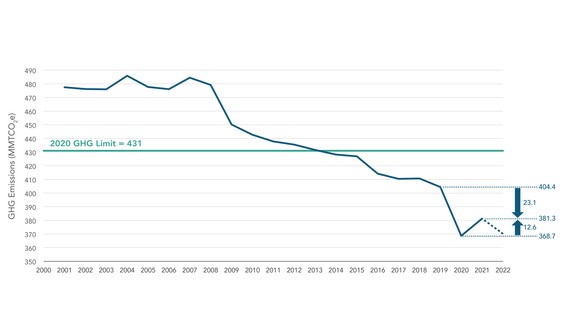
Early 2022 data preliminarily shows that the state’s declining emissions trend continues.
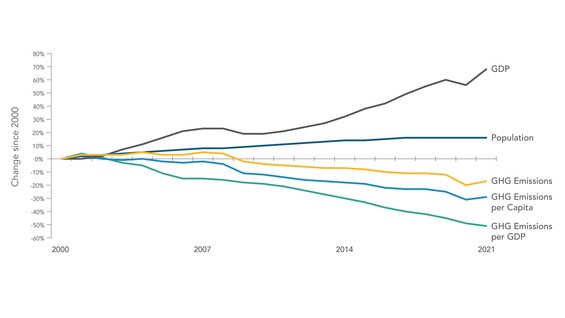
Compared to 2020, 2021 emissions rose by almost 13 million metric tons, which represents a 3% increase, even as California saw an 8% increase in economic activity following the height of the COVID-19 pandemic. Compared to pre-pandemic 2019 figures, emissions have decreased by 23 million metric tons, which is the equivalent of removing 5 million passenger cars from California’s roads.
“The inventory data demonstrate that California’s commitment to an economy-wide approach toward emissions reductions is putting us on a path toward cleaner air and a healthier future,” said CARB Executive Officer Dr. Steven Cliff. “The results also show that we need to continue doubling down on the work that will make a carbon-neutral California a reality.”
2021 emissions decreased from 2020 data in the following sectors:
• Agricultural emissions went down, driven by the use of digesters, which remove methane from the air and turn it into an alternative fuel source.
• For the first time in 20 years, refrigerant emissions leveled out due to CARB regulations across various uses.
2021 emissions increased from 2020 data in the following sectors:
• Transportation emissions grew 10 million metric tons, which reflects the return to daily activities and work following the rescinding of pandemic stay-at-home orders.
• Energy sector emissions increased by 2.8 million metric tons, likely driven by an increase in demand and lower hydroelectric power.
• Emissions from the industrial sector increased by 0.6 million metric tons, specifically from refineries and petroleum extraction, which may also be tied to demand from the increased economic activity.
California’s annual statewide GHG Inventory relies on data from the Mandatory Reporting Regulation, which requires key sectors to submit emissions data, as well federal and state sources.
More information can be found on CARB's website.
HVIP FY23-24 Funding and Policy Changes
November 17, 2023
On November 16, 2023, the California Air Resources Board (CARB) approved the Fiscal Year (FY) 2023-24 Funding Plan for Clean Transportation Incentives, which includes policy changes and an allocation of over $400 million for school buses, drayage trucks, and small truck fleets to be administered by the Clean Truck and Bus Voucher Incentive Project (HVIP), including through Innovative Small E-Fleets (ISEF) and the Public School Bus Set-Aside.
In addition, over $500 million remains available now for new voucher requests across all vehicle types and fleets. Available funding is updated daily at www.CaliforniaHVIP.org/funding.
The Funding Plan outlines the following adopted policy changes for HVIP:
Effective November 17, 2023: New Small Fleet Definition and Doubling Small Fleet Voucher Amounts
For requests placed on or after 11/17/23, small fleets are now defined as public fleets with 20 or fewer medium- and heavy-duty (MHD) vehicles or private fleets with 20 or fewer MHD vehicles and less than $15 million in annual revenue. The change in small fleet definition will apply to all uses, including eligibility for the 15% Disadvantaged Community (DAC) Plus Up, additional fund stacking flexibility with State incentive programs (e.g. Moyer, Volkswagen), and newly increased base vouchers.
The base voucher will be doubled for small public and private fleets submitting new voucher requests on or after 11/17/23 in Standard HVIP, the Drayage Truck Set-Aside, or the Public Transit Set-Aside, for any HVIP-eligible vehicles. This includes requests that would have otherwise been ISEF standard purchases. All standard purchases formerly made through ISEF will now be funded through HVIP and all existing ISEF standard purchase vouchers will be automatically adjusted to reflect the new HVIP small fleet incentive levels. No action is required by dealers and purchasers, and additional information will be forthcoming. Innovative Solutions such as short-term leases, rentals, and Truck-as-a-Service will continue to be available through ISEF.
An example calculation can be viewed in the FAQs at www.CaliforniaHVIP.org/About. The +100% base adjustment will replace the existing fleet size base adjustment of +15% which was previously in effect for private and public fleets with 10 or fewer MHD vehicles.
The criteria used to determine eligible fleet size follows the definition in the FY22-23 Implementation Manual until 1/1/24, when the fleet size definition will be updated to align with the Advanced Clean Fleets regulation, as described below.
Important note for dealers and purchasers: Updates to the online Voucher Processing Center are underway, and voucher-specific updates will be provided regarding forthcoming adjustments to vouchers to address the above policies in the coming weeks. For example, increased voucher amounts or adjustments to DAC eligibility will not be visible immediately on 11/17.
Effective January 1, 2024:
Updated Fleet Size definition: for Standard HVIP and all Set-Asides except for the Public School Bus Set Aside, HVIP’s fleet size definition for voucher requests placed on or after 1/1/24 will be inclusive of the fleet’s vehicles domiciled anywhere globally that are over 8,500 lbs GVWR, including all such vehicles under common ownership or control, as defined in HVIP's Implementation Manual.
Fleet size is inclusive of vehicles registered with the California Department of Motor Vehicles (DMV) as non-operational, but excluding off-road vehicles, unregistered vehicles, and those registered with the DMV as non-revivable junk or dismantled.
PO age: Starting 1/1/24, Purchase Orders or other binding sales agreements for private-entity purchasers can be dated no earlier than 90 calendar days before the date the voucher request is submitted. For public-entity purchasers, POs or other binding sales agreements can be no older than March 30, 2023.
Additional limitations may apply to fleets subject to the Advanced Clean Fleet Regulation.
More information about fleet size and POs is available in the FAQs at www.CaliforniaHVIP.org/About.
Other updates:
- The existing +25% Early Adopter voucher enhancements for Refuse and Drayage, described at CaliforniaHVIP.org/funding, are extended to 12/31/24.
- Public transit fleets and fleets purchasing refuse vehicles will have an annual voucher request cap of 50 starting in 2024, in line with the existing cap for drayage purchasers. For other purchasers, the cap remains 30 vouchers per calendar year.
- The existing Manufacturer Rolling Soft Cap will continue until new Performance Review parameters are determined; a public Workgroup is anticipated in early 2024.
- Vehicle-to-Grid functionality, or bi-directional charging, will be required on all HVIP battery electric school bus vehicle eligibility applications submitted to CARB on or after 1/1/24. Applications are found in the Manufacturer Resources section at CaliforniaHVIP.org/sellers.
- Private fleets of more than 50 vehicles remain eligible to request HVIP vouchers until January 1, 2025, postponing by a year the policy set in the FY 2022-23 Funding Plan.
- The FY23-24 Implementation Manual is anticipated to be released in spring 2024 with more information about these changes, with mandatory Dealer Training to be announced in advance.
For more information, please contact [email protected].
CARB approves incentive funding plan that invests in equitable transition to zero-emission future
November 16, 2023
CARB approves incentive funding plan that invests in equitable transition to zero-emission future
Almost $624 million investment plan directs 63% of its resources toward projects that focus on equity and target priority populations
________________________________________
SACRAMENTO – The California Air Resources Board (CARB) today approved an almost $624 million funding plan for its incentive programs that will continue to help Californians – from truck fleet operators to commuters – make the switch to zero-emission vehicles.
Under the plan, 63% of the 2023-2024 fiscal year’s investment funds will go toward bolstering equitable access, resources, and support for low-income and disadvantaged communities.
The Fiscal Year 2023-2024 Funding Plan for Clean Transportation Incentives also marks the launch of an expanded outreach process that includes surveys, meetings with community-based organizations, and the addition of monthly virtual meetings held in the evenings to increase access for Californians who have barriers to participating in the public process.
“The shift toward zero emission is only possible if every Californian has access to new and emerging vehicle technology, and our funding plan reflects the importance of equitable access in working toward a clean air future,” said CARB Chair Liane Randolph. “The funding plan also offers a wide range of tools to get Californians into cleaner options, from the trucks that transport goods across the state to e-bikes that can make it easier for residents to meet their everyday mobility needs.”
Key highlights in the funding plan include:
- Continued funding to support the launch of a statewide Clean Cars 4 All and financing assistance projects, which will provide up to $12,000 in vouchers and financing assistance to help low-income Californians replace older cars with zero-emission vehicles.
- Funding to support the new e-bike incentive project that will give up to $1,250 in vouchers to low-income Californians.
- $375 million to help public school districts purchase zero-emission buses.
- $10 million to launch a capacity-building educational effort that will give communities the tools they need to plan a clean mobility project and learn how to apply for funding resources.
- Almost $60 million to support shared mobility projects, such as car or bike-sharing, in underserved communities.
- $80 million for drayage fleet operators, as their transition toward zero-emission options begins in 2024.
- $14.3 million for a financing assistance program that targets operators and owners of small fleets.
- $14.3 million in vouchers for zero-emission off-road equipment, such as cargo-handling or construction equipment.
CARB’s incentive programs are intended to encourage the adoption of zero-emission options and have successfully supported the advancement of technology and encouraged the market to move toward cleaner options. There are now more than 100 light-duty vehicle options available for Californians to purchase, and more than 500 models available for heavy-duty vehicles and equipment. More than 1.6 million zero-emission vehicles are on Californians roads – two years ahead of schedule – and 1 out of every 4 cars sold in California is zero emission. California also recently surpassed its sales goals for zero-emission heavy-duty trucks two years ahead of schedule, before regulations officially kick in.
Now Available – HVIP Public Transit Bus Set-Aside Appendix H
October 31, 2023
The Public Transit Bus Set-Aside Appendix H (Appendix H) is now available. As an addition to the HVIP FY22-23 Implementation Manual, Appendix H details the flexibilities granted to transit agencies participating in HVIP via the Public Transit Bus Set-Aside (Transit Set-Aside).
New updates to the Transit Set-Aside, from Appendix H, and a summary of other recent updates:
- 36-Month Redemption Timeline: Transit agencies have 36 months rather than 18 months to redeem their vouchers.
- Letter of Intent: In lieu of a purchase order, transit agencies are permitted to submit a letter of intent (LOI) at the point of voucher request submission. The LOI may be dated no earlier than 1/1/2023.
- Delivery Document: To enable a faster redemption process for HVIP approved dealers, a Delivery Document may be submitted in lieu of a Bill of Lading and in advance of final payment.
- Local Match on Federal Grant Applications: HVIP is now eligible to be used for local match in federal Bus Competitive Program funds, such as FTA’s Low and No Emission Vehicle Program.
- +15% Voucher Modifier: The 15% voucher modifier continues to apply to bus vouchers for transit agencies.
Eligibility: The Transit Set-Aside is reserved for transit buses purchased by a city or county government; a transportation district / transit district; or a public agency. Public transit includes paratransit and microtransit services operated by or on behalf of a public transit agency. Tribal entities requesting transit bus vouchers are also eligible.
Appendix H and sample documents to support Transit Set-Aside voucher requests are available on the HVIP Purchasers page.
Development of the California Air Resources Board’s (CARB) FY23-24 Funding Plan for Clean Transportation Incentives, which includes HVIP, is now underway, and more information will be published at www.CaliforniaHVIP.org when available later this year.
Come See Us!
The EnergIIZE and HVIP teams will be available for in-person discussions at the CALACT Autumn Conference & Expo, Nov. 1 – 2 (Booth #310) and CTA Fall Conference & Expo, Nov. 16 – 17 (Booth #706).
For questions, please reach out to [email protected].
Microgrids: Best Practices for ZEB Resiliency Report Now Available
With the adoption of zero-emission buses increasing across the United States, transit agencies are faced with real challenges for future energy management and increasingly detrimental consequences in the event of utility grid outages. CALSTART's latest report, Microgrids: Best Practices for ZEB Resiliency, addresses the utility of microgrids in the event of outages. This new report, funded by California Air Resources Board (CARB) Hybrid and Zero-Emissions Truck and Bus Voucher Incentive Project (HVIP), breaks down how microgrids not only ensure an uninterruptible power supply but will also work to offset utility costs as demand for and the cost of electricity increases in the coming decade. Take away the top five high-level factors that transit agencies must consider for microgrids on a project-by-project basis, plus examples of real-world transit microgrid projects.
Published June 23, 2023
New Voucher Incentive Program Report Launches
As governments and industry work to accelerate the replacement of diesel engines with zero-emission technology at the pace required by science-based climate targets, the voucher incentive program (VIP) has proven to be a powerful tool to establish viability of zero-emission trucks and buses. CALSTART’s latest report Voucher Incentive Programs: A Tool for Zero-Emission Commercial Vehicle Deployment offers a deep dive into the VIP model and how it ensures faster adoption of zero-emission trucks, buses, and other commercial vehicles through direct and upfront reductions in purchase price.
HVIP is the earliest model in the United States to demonstrate the flexibility and effectiveness of point of sale incentives, and this paper outlines the basic steps in an effective VIP as well as success stories across the country that exhibit the core strengths of the VIP model: design simplicity, transparency and certainty of outcome, and flexibility/adaptability. It also highlights lessons learned and recommendations from the jurisdictions where the VIP model has been implemented, providing insights on how to make vehicle acquisition easier and more affordable and how to seamlessly integrate funding requirements to produce a simple, stable, and successful program.
Published May 18, 2023
Supporting Small Fleets in the Transition to Zero Emission Trucks Report
Green For All's report primarily focuses on small fleets with a keen interest in minority-owned fleets in order to address a critical gap in both the literature and the conversation about truck electrification. Through interviews, a digital survey, and a literature review, this report set out to explore what perceptions and existing knowledge small fleets already have about ZETs, the barriers to electrification they anticipate, the solutions they find promising, and the best processes to intentionally engage them in shaping ZET policies and programs. The findings and recommendations are based on this initial research and offer learnings that can help inform forthcoming programs and policies.
To read the full report, visit Dream.org's website.
Published February 20, 2023
Follow the funds! Voucher data updated monthly
Follow the Funds! Voucher data and map are updated monthly. Learn where HVIP-funded vehicles are benefiting California, including voucher requests and vehicles already deployed.
Visit https://californiahvip.org/impact/#deployed-vehicle-mapping-tool to learn more.
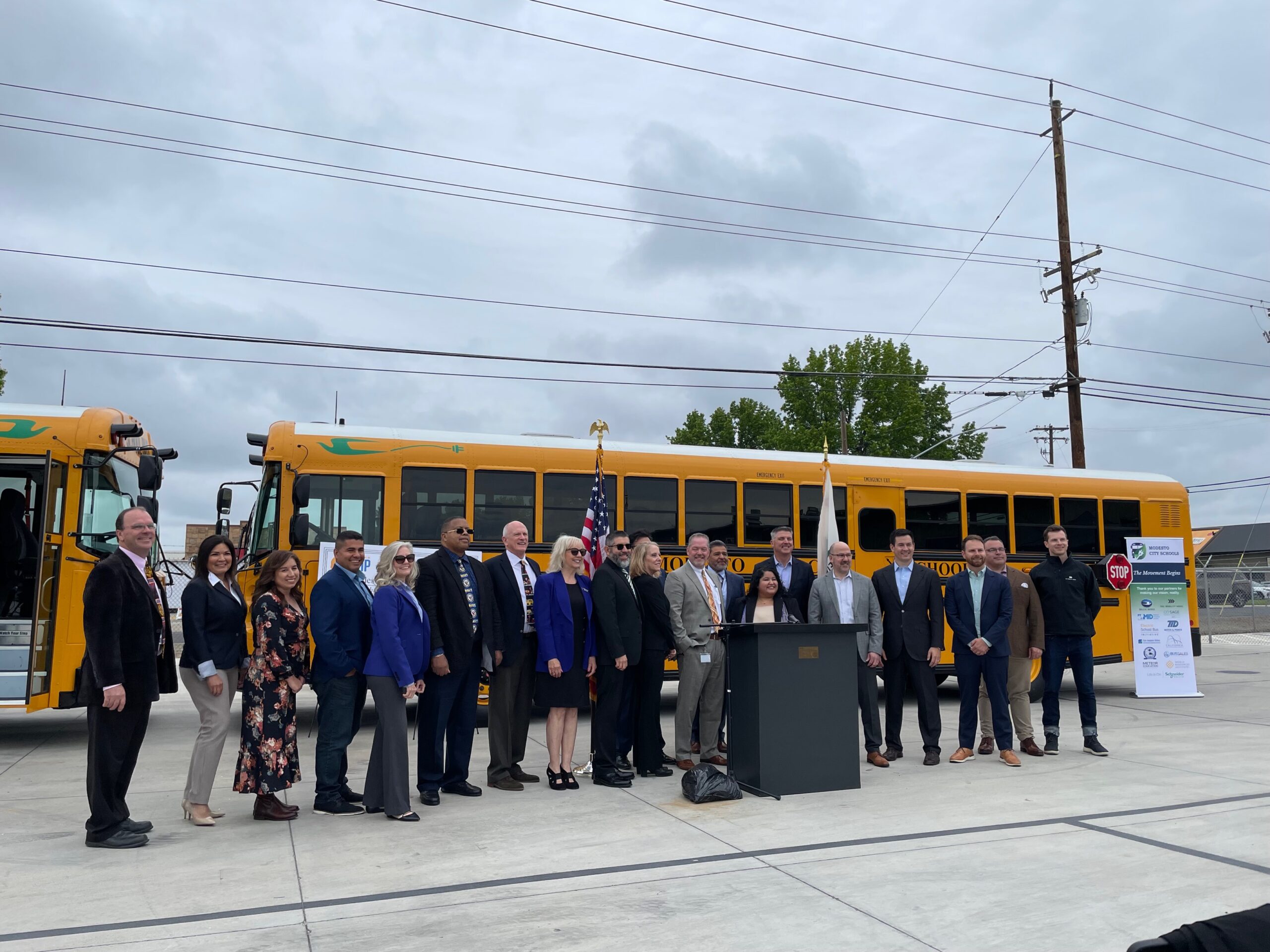
Modesto City Schools to Receive 30 Electric School Buses (4/20/2022)
On Tuesday, April 19, 2022, Modesto City Schools celebrated the purchase of 30 electric school buses. This purchase was made possible with the assistance of funding through the HVIP program.
HVIP Public School Bus Set-Aside for Small and Medium Air Districts
$130 Million Set-Aside for Eligible School Buses
The California Air Resources Board (CARB) approved a $130 million set-aside intended to cover nearly, if not all, of the full cost of new zero-emission school buses for public school districts and other qualifying entities located in small-sized air districts and in medium-sized air districts.
Public School Bus Set-Aside Flyer
Applications for the Public School Bus Set-Aside for Small and Medium Air Districts (Public School Bus Set-Aside) will be accepted when HVIP opens, which is anticipated for late March. More information will be provided to all stakeholders and posted to www.CaliforniaHVIP.org and www.CaliforniaHVIP.org/Purchasers when the HVIP Implementation Manual for FY21-22 funds is published, before HVIP opens.
Mark Your Calendar – March 2nd Working Group
Join us 11am-12pm (PT) on Wed., March 2nd for a working group meeting on the available and upcoming funding opportunities for electric school buses (ESBs), including the HVIP Public School Bus Set-Aside for Small and Medium Air Districts. The March 2nd working group is a part of a series of monthly California Electric School Bus Working Group Meetings, convened by CALSTART, please spread the word!
Purchaser Eligibility for Set-Aside Funds
Eligible applicants in small and medium air districts should apply when HVIP opens. For the first 90 days, funding will be prioritized for applicants that are in a small air district AND are also in a Disadvantaged Community. After the initial 90 days, requests are first come first served for all qualifying purchasers in all small and medium-sized air districts.
At the time of their initial funding request, applicants will need to identify bus(es) to scrap / retire, but do not need to know yet what bus(es) they potentially want to purchase. HVIP staff will connect applicants with an HVIP Approved Dealer who will complete the rest of the application on their behalf.
Before HVIP opens, school buses eligible for the set-aside funds will be indicated on the HVIP Eligible Vehicle Catalog. See the flyer for details about the old bus scrappage requirement.
All applicants must serve students at the K-12th grade level. Eligible applicants include:
- CA Public School Districts or Public Charter Schools
- CA Joint Power Authorities (JPAs)
- CA County Offices of Education (COEs)
- Division of State Special Schools of the CA Department of Education
Details of this set-aside are subject to change until the HVIP FY21-22 Implementation Manual is published.
Outreach is underway now! Please reach out to [email protected] with any questions or to subscribe to Public School Bus Set-Aside updates. We’re here to help.
Posted 2/17/2022
Zeroing in on ZETs Report Available (2/4/2022)
Zeroing in on Zero-Emission Trucks is an inventory of Class 2b-8 zero-emission trucks (ZETs) in the U.S. as of December 2021. The report provides insight on ZET market trends as the industry prepares for an injection of federal funding for charging infrastructure, multiple states implement clean truck regulations, and California prepares to release an additional $873 million in purchase incentives for commercial vehicles and infrastructure.
The report found that 738 ZETs are deployed in California. Of those, 448 are funded by HVIP.
The report is now available online.
Zeroing in on ESBs Report Available (1/19/2022)
The latest in the Zeroing in on series, CALSTART has released Zeroing in on ESBs, an inventory of electric school buses (ESBs) in the U.S. As of September 2021, there are 1,738 ESBs funded, ordered, delivered, and deployed across the U.S. You can also see which states have the most ESBs by state and by EPA region.

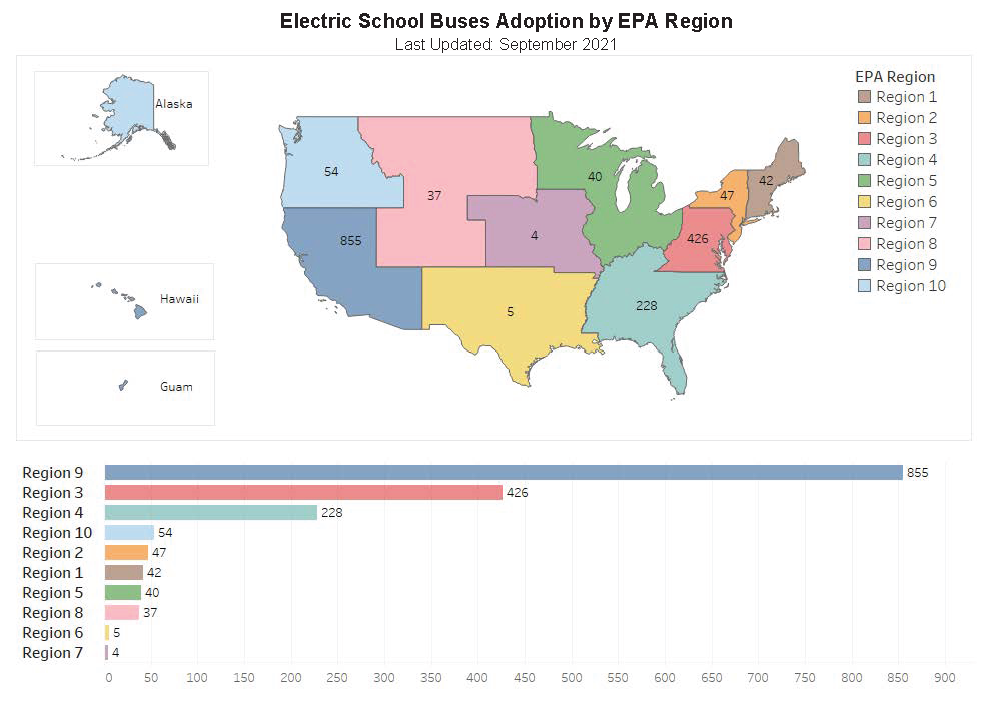
More information can be found in the report's press release.
Incentives for Commercial Zero Emission Vehicle Infrastructure
Posted 1/13/2022
Zeroing in on ZEBs Report Available (1/11/2022)
CALSTART's annual inventory of zero-emission buses (ZEBs), “Zeroing in on ZEBs”, has just been released. The report provides insight on the current state of ZEBs ahead of $5.25 billion in Infrastructure Investment and Jobs Act funding through the Federal Transit Administration’s Low-No Program. Great news found in the report is that full-size ZEBs have grown to 3,533 buses nationally, an increase of 27% since the 2020 count.
California continues to lead in the deployment of full-size ZEBs, with New York and Washington rounding out the leaderboard in the totals by state. This year’s report also includes a breakdown of full-size and small buses, as small ZEB deployment increased by 51%.
More information can be found in the report's press release.
Posted 1/11/2022
HVIP Wave 3 Summary and Waitlist (11/15/2021)
HVIP Wave 3 Funding Summary and Waitlist
November 15, 2021
HVIP opened to new voucher requests at 10 a.m. Thursday, October 28, and all available funds, $63 million, were requested within 9 minutes. This was the third and final wave of funding for 2021.
Although HVIP remains temporarily closed to most new voucher requests until more funds, additional funding will be available in 2022. In the meantime, HVIP will continue to support voucher requests for Class 8 zero-emission tractors performing drayage operations NOW with a drayage waitlist, in order to help advance this key zero-emission market segment.
A waitlist is now open for dealers/manufacturers who sell HVIP-eligible class 8 tractors performing drayage operations, that are currently on the HVIP-eligible vehicles list as Drayage Capable. Dealers/manufacturers must be currently on the HVIP-eligible dealer list at californiahvip.org/dealerlist. Drayage dealers/manufacturers received additional instructions via email earlier today about how to participate; if you are a drayage dealer/manufacturer who currently participates in HVIP and have not received instructions, please reach out to [email protected].
This waitlist also currently includes ANY eligible voucher requests that were submitted after funding was fully requested during the wave 3 opening on October 28, but BEFORE HVIP closed later that same morning. Dealers can determine whether their vouchers are on the waitlist if the “Waitlist” checkbox in the Voucher Details tab of the online Voucher Processing Center is checked on those vouchers. Voucher requests without the checkbox checked are unfunded, based on timestamp. Affected dealers have already been notified. Please contact [email protected] for information about the status of specific vouchers.
The CARB Board will consider the FY21-22 Funding Plan for Clean Transportation Investments, including funding for HVIP, at the Friday, November 19 Board meeting. The Funding Plan includes historic levels of funding for zero-emission technologies. More information about 2022 funding will be announced when available from CARB.
HVIP Opens on October 28 to New Voucher Requests
The Hybrid and Zero-Emission Truck and Bus Voucher Incentive Project (HVIP) will open to new voucher requests at 10 a.m. Pacific on Thursday, October 28, 2021, with its wave 3 of funding (approximately $62 million) on a first-come, first-served basis.
HVIP opened to new voucher requests on June 8 (wave 1) and August 10 (wave 2) with its FY 20-21 funding and those funding allocations have been fully requested.
Purchase Orders for Voucher Requests
A valid signed Purchase Order (or other binding Agreement, Contract, Buyer’s Order, or action/resolution by a government entity’s governing body) is required at the time a voucher request is made. Non-binding agreements are not sufficient to reserve a voucher. A purchase order or other sales agreement that was eligible at the time of the initial opening in June will remain eligible throughout the project year, including wave 3.
- POs for private-entity purchasers can be no older than May 29, 2021
- POs for public-entity purchasers can be no older than March 10, 2021
Dealer Training
Any dealers planning to request vouchers for wave 3 who have questions about their VPC login credentials or other concerns should contact [email protected] immediately to ensure their seamless participation. Dealers who are interested in participating in wave 3 must contact us by October 18th in order to be trained and approved on time to participate in wave 3. All dealer training requirements must be completed by October 25th in order to get access to the online Voucher Processing Center in advance of the release of the third wave of funds this fall.
If you have questions about the status of specific vouchers, please contact [email protected].
Guidance for Purchasers
Posted 10/14/2021
CCI Reports Implementation of $9 Billion in Projects to Reduce GHG
August 24, 2021
California Climate Investments Reports Implementation of $9 Billion in Projects to Reduce Greenhouse Gases
California officials say clean vehicle purchases and new projects that have come online since December 2020 will eliminate 11,000 tons of air pollutants and toxics from California’s air. The California Air Resources Board administers the California Climate Investments program, funded with proceeds from the State’s Cap-and-Trade GHG emissions reduction program.
Since 2013, the Legislature has appropriated $15.4 billion in California Climate Investments funds for projects statewide, $9 billion of which are either underway or completed. Approximately $4.5 billion of all implemented funds directly benefit California’s priority populations, which include disadvantaged and low-income communities and low-income households statewide. California Climate Investments will provide about 70 million metric tons of GHG emissions reductions, the equivalent of taking 14 million cars off the road for a year. This does not include expected GHG emissions reductions attributable to the High-Speed Rail project.
More than 20 state agencies manage investments in over 70 programs. New investments since December 2020 total 53,800 projects and will reduce greenhouse gas (GHG) emissions and promote a healthier California through these projects, including 51,000 rebates for the purchase of zero-emission vehicles and 697 affordable housing units.
More information can be found in the eblast and on CCI's website.
HVIP's Second Wave of Funding Fully Subscribed (8/10/2021)
August 10, 2021
HVIP's Second Wave Funding Fully Subscribed
The Hybrid and Zero-Emission Truck and Bus Voucher Incentive Project (HVIP) opened to new voucher requests on August 10. Wave 2 of FY20-21 funding has now been requested, approximately $12 million.
Additional HVIP funds are expected this fall. More information will be provided when available from the California Air Resources Board.
For questions about dealer training, please contact [email protected].
For questions about the status of specific voucher requests, please contact the Voucher Processing Center at [email protected]. Dealers should expect voucher-specific outreach from the Voucher Processing Center during review.
Newly Updated Tool IDs Vehicles Eligible for HVIP Funding
Newly Updated Tool IDs Vehicles Eligible for Incentive Funding in California and New York
July 7, 2021
An innovative online tool that catalogs global zero-emission truck and bus models now makes it easier to identify the vehicles eligible for significant point-of-sale discounts in California and New York. CALSTART’s Zero-Emission Technology Inventory (ZETI) now features Hybrid and Zero-Emission Truck and Bus Voucher Incentive Project (HVIP) and New York Truck Voucher Incentive Program (NYTVIP) “badges” on vehicle model descriptions. This new information was added to help raise awareness around the types of vehicles these two leading edge programs support.
More information can be found in the press release.
Record year for California Climate Investments: $3.1 billion invested in 2020 across California (5/10/2020)
Despite the challenges posed by a global pandemic and unprecedented heat and wildfires, 2020 was another record year for California Climate Investments with more than $3.1 billion invested in more than 51,000 projects across California’s 58 counties and with total program investments since 2014 benefitting priority populations topping $4 billion. Projects implemented in 2020 alone will reduce greenhouse gas emissions by nearly 18 million metric tons of carbon dioxide equivalent over the course of their lifetimes.
Of the $3.1 billion investment in 2020, $1 billion is benefiting disadvantaged and low-income communities and households — collectively referred to as priority populations. To date, more than $4 billion in California Climate Investments funds have benefited priority populations — nearly half of all project investments.
Nearly a half million projects have been funded so far since the first California Climate Investments appropriations were made in 2014. These projects are providing substantial benefits to communities across the state while making significant greenhouse gas emission reductions. To date, California Climate Investments projects are expected to reduce greenhouse gas emissions by 66 million metric tons of carbon dioxide equivalent during their lifetimes, not including an additional 102 million metric tons expected from a completed High-Speed Rail project. The $3.1 billion 2020 investment included nearly $1.4 billion in funds implemented last year by the California High-Speed Rail Authority.
Select highlights from the 2021 Annual Report include:
• More than 40,000 consumer rebates issued for zero-emission and plug-in hybrid vehicles, with a growing percentage, 38 percent last year, going to lower-income applicants
• 2,462 new, affordable housing units under contract
• 128,000 acres of land preserved, restored or treated
• 148,000 tons of waste diverted from landfills
• 341 million gallons (gas and diesel) fuel use avoided
• 500,000 trees planted
More information can be found in the eblast announcements one and two and on California Climate Investments' website.