
Standard HVIP Voucher Funding Now Closed
Standard HVIP voucher funding is now closed, as all available funds have been fully committed. HVIP is aiming to reopen and release additional funding by the end of 2026. Updates will be shared as soon as a reopening date is confirmed.
The Public Fleet and Drayage categories remain open, and eligible purchasers may continue submitting voucher requests as usual.
Explore Additional Funding
Purchasers seeking funding for Class 2b – Class 8 battery electric truck funding may want to explore the California Clean Fuel Reward.
For the latest policies and eligibility criteria, visit the Implementation Manual or HVIP FAQs.
If you have any questions, please contact us at [email protected].

Port of Los Angeles and Long Beach Plus Up Funding is Now Open
The Port Plus Up program is now open with over $5 million available for zero-emission Class 8 drayage trucks serving the Ports of Los Angeles and Long Beach.
WHAT'S AVAILABLE
Voucher enhancements funded by the Ports are stacked on top of the standard HVIP drayage voucher amount of $150,000 per truck:
-
- $100,000 per truck for small drayage businesses (fleets of 20 trucks or fewer)
- $75,000 per truck for larger drayage fleets (fleets of more than 20 trucks)
HOW TO APPLY
Funding is available on a first-come, first-served basis through the existing HVIP voucher request process and online Voucher Processing Center. Voucher requests follow standard HVIP requirements; eligible vehicles and dealers are listed at californiahvip.org.
To receive Port funding, purchasers must agree to the following:
-
- Provide drayage service to the San Pedro Bay port complex—at least 50 trips per year for three years after voucher redemption, including at least 25 trips to the Port providing the enhancement. A trip is defined as one loaded gate entry to a port terminal.
- Register the truck in the San Pedro Bay Ports' Drayage Truck Registry (PDTR) and comply with its insurance requirements.
- Remain registered in the PDTR for three years after redemption.
- Begin using the truck in drayage service no later than 60 days after delivery.
Additional details are provided in the HVIP voucher request form and Terms and Conditions form.
Not performing drayage at the Ports? Funding is still available through standard HVIP, including over $90 million in drayage truck set-aside funds. Visit californiahvip.org/funding for funding updates.
ABOUT THE CLEAN TRUCK FUND
This program is made possible through two dedicated funding streams—the Port of Los Angeles Clean Truck Fund and the Port of Long Beach Clean Truck Fund—established to accelerate the transition to zero-emission drayage trucks at the San Pedro Bay port complex. The program is administered by CALSTART through the existing HVIP infrastructure.
ABOUT THE PORT OF LOS ANGELES
The busiest seaport in the Western Hemisphere, the Port of Los Angeles is North America's leading trade gateway and has ranked as the number one container port in the United States for 22 consecutive years. San Pedro Bay port complex operations facilitate one in nine jobs across Los Angeles, Orange, Riverside, San Bernardino, and Ventura counties.
ABOUT THE PORT OF LONG BEACH
A global leader in green port initiatives, the Port of Long Beach handles trade valued at $200 billion annually and supports 2.6 million jobs across the United States. Named "The Best West Coast Seaport in North America" for five consecutive years, the Port is investing $2.2 billion in capital improvements over the next decade to enhance capacity, competitiveness, and sustainability.
Questions? Visit californiahvip.org or contact [email protected].

HVIP and Tesla Semi-Truck Facts
HVIP has published an FAQ addressing recent media coverage of Tesla Semi-Truck participation in the program. The document provides context and additional detail in response to a Febrero Los Angeles Times article. For questions about HVIP eligibility, funding, and program guidelines, please refer to HVIP and Tesla Semi-Truck Facts.
California Makes History: $1 Billion in HVIP Vouchers Paid
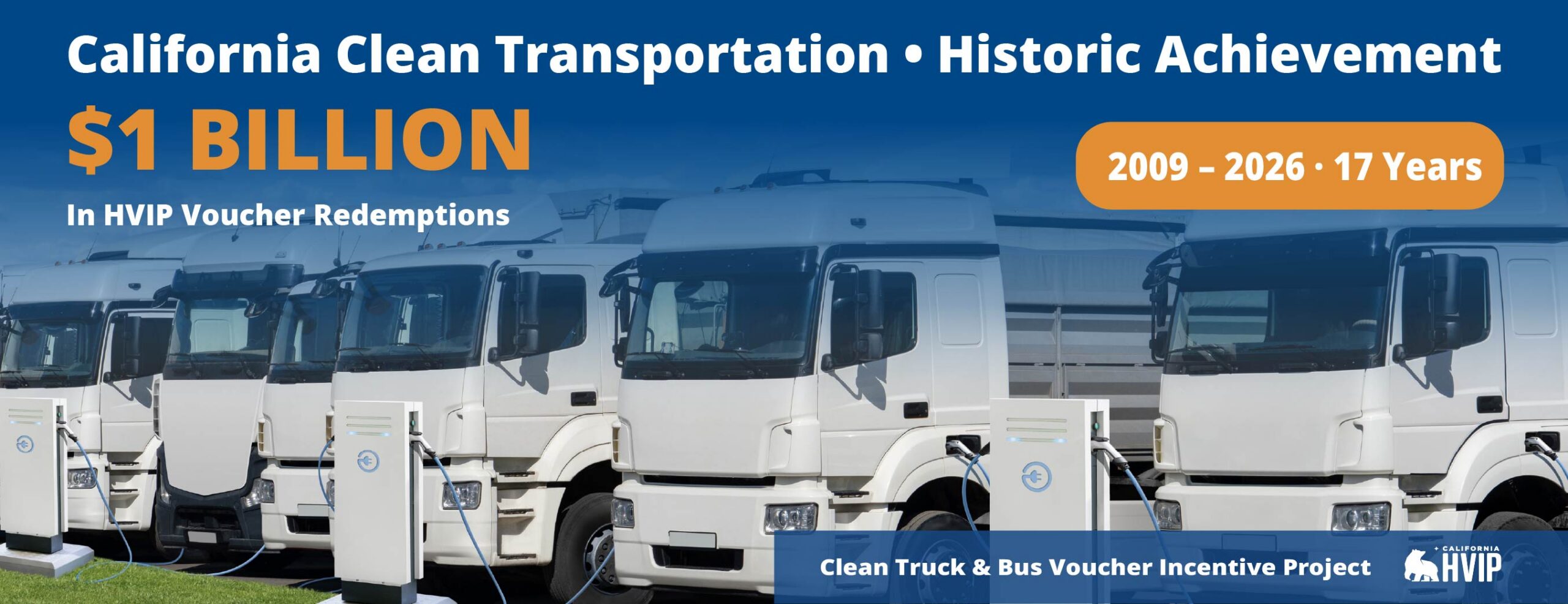
California HVIP Surpasses $1 Billion in Commercial Medium- and Heavy-Duty Clean Transportation Vouchers
We're thrilled to announce a historic milestone: California's Clean Truck and Bus Voucher Incentive Project (HVIP) has officially surpassed $1 BILLION in voucher redemptions, a landmark achievement in our collective commitment to clean transportation.
This is a joint achievement between the California Air Resources Board (CARB), funders of the project, and CALSTART, administrators of the California HVIP Project. Launched in 2009 by CARB, and part of the California Climate Investments—which uses billions of Cap-and-Invest revenue to support clean transportation—HVIP has become one of the most reputable clean transportation incentive initiatives in the United States.
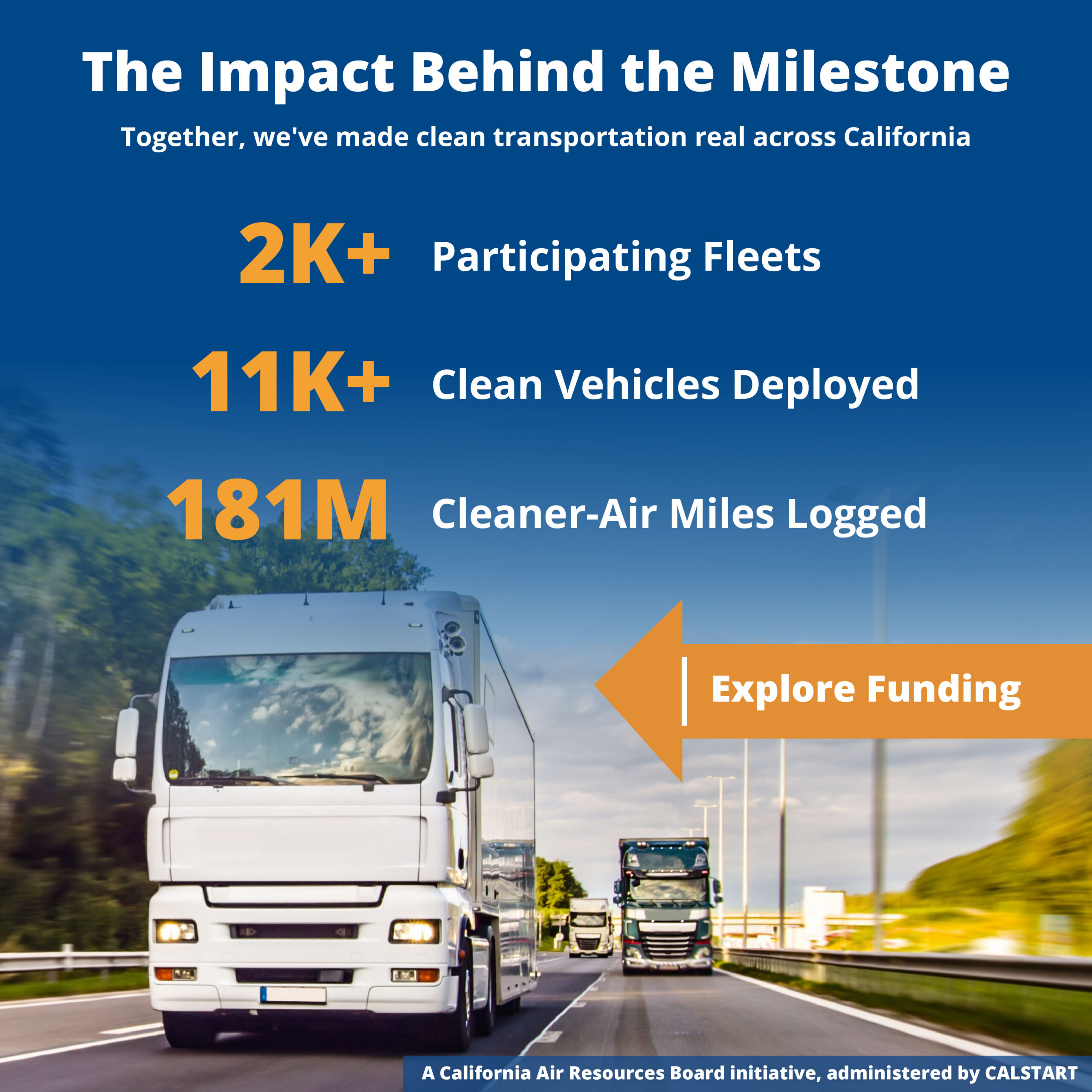
That billion isn't just a number — it represents real change on California's roads. Here’s a look at the impact we’ve built together:
- Supported more than 2,000 participating fleets in their transition to cleaner technology;
- Deployed over 11,000 medium- and heavy-duty clean vehicles across California;
- Logged 180+ million cleaner-air miles; and
- Reduced nearly 1.5 metric tons of CO₂ equivalent emissions and over 2,200 tons of NOx.
Read the full press release
Your participation has been instrumental in reaching this milestone. Together, we're proving that zero-emission transportation is not only possible, but it's sustaining real market growth, with 38 OEMs and over 150 vehicle models now available through HVIP.
HVIP remains committed to expanding access and affordability for fleets of all sizes. Whether you're just beginning your electrification journey or looking to grow your zero-emission fleet, we're here to support you every step of the way.
HVIP funding is available and remains open. Fleets and dealers are encouraged to submit voucher requests now! Explore funding opportunities at californiahvip.org/funding or find eligible vehicles in the vehicle catalog.
Contact Cal Fleet Advisor for personalized support.
Thank you for driving California’s clean transportation future.
CALSTART HVIP Team
Lista de espera para reservas de transporte VIP
Esta publicación se actualizó el 12 de junio de 2025 (desplázate hacia abajo para ver la actualización).
A fecha de 23 de abril de 2025 a las 17:50 h (hora del Pacífico), el programa de reserva para el transporte público ha alcanzado su cupo máximo. Se abrirá una lista de espera para aceptar solicitudes de vales adicionales hasta un 10 % de la asignación total del programa de reserva para el transporte público (13,5 millones de dólares). Los vales presentados después del 23 de abril de 2025 a las 17:50 h (hora del Pacífico) se añadirán a la lista de espera.
Si se cancelan los vales de transporte público ya asignados, se recurrirá a la lista de espera para financiar vales adicionales con los fondos de los vales cancelados.
Las listas de espera destinan los fondos de los pedidos de vehículos cancelados a posibles solicitudes de vales que están listas para ser tramitadas mediante el proceso estándar de revisión y canje del Proyecto de Incentivos para Camiones y Autobuses Limpios (HVIP). La lista de espera no garantiza la financiación de las solicitudes de vales presentadas. Las solicitudes incluidas en la lista de espera se tramitan por orden de llegada.
Acerca de la reserva para el transporte público: Con el fin de continuar la transición hacia flotas de autobuses de cero emisiones, la reserva para el transporte público del HVIP financia a las agencias de transporte público sujetas a la normativa Innovative Clean Transit (ICT) que adquieran autobuses de transporte público admisibles para el HVIP antes de lo previsto o superando los objetivos reglamentarios. Cualquier agencia de transporte público sujeta a la normativa ICT debe cumplir todos los objetivos reglamentarios y presentar los informes correspondientes para poder canjear un vale HVIP. Las solicitudes de vales presentadas a la lista de espera deben ser elegibles para la reserva para el transporte público.
Se notificará a los concesionarios y compradores si su solicitud de vale queda en lista de espera para la reserva destinada al transporte público.
**¡Prepárate para cuando se abran nuevas convocatorias de financiación!** Se prevé que en los próximos meses se publiquen nuevas convocatorias de financiación del programa HVIP en todas las categorías. Únete a nuestra lista de notificaciones prioritarias para ser de los primeros en saber cuándo hay nuevas convocatorias disponibles.
Para obtener información sobre la disponibilidad de financiación, visite nuestra página de financiación.
ACTUALIZACIÓN: A fecha de 3 de junio de 2025, la lista de espera para el programa Transit Set-Aside está CERRADA. Las solicitudes de vales en lista de espera podrán ser retiradas de la lista de espera y revisadas si se dispone de fondos, por orden de llegada.
Si tiene alguna pregunta, póngase en contacto con [email protected].
HVIP alcanza un crecimiento récord a medida que se expande el mercado de camiones y autobuses con cero emisiones
El Programa de Incentivos mediante Bonos para Camiones y Autobuses Ecológicos de California (HVIP) está experimentando un auge sin precedentes, con un aumento del 177 % en el canje de bonos entre 2023 y 2024; además, los datos de principios de 2025 indican que esta tendencia al alza continúa a medida que se acelera la electrificación de las flotas en toda California.
La transición hacia el transporte sostenible está cobrando impulso en las carreteras de California. Solo en febrero de 2025 se pusieron en circulación más de 200 camiones y autobuses de cero emisiones financiados por el programa HVIP, con más de 31 millones de dólares en vales canjeados.
El programa HVIP ofrece descuentos en el punto de venta para que los vehículos de cero emisiones (ZEV) resulten más asequibles y accesibles para las flotas y las empresas de California. En los últimos 15 años, el HVIP ha destinado 754 millones de dólares para ayudar a más de 2.000 flotas participantes a adquirir y poner en servicio más de 10.000 camiones y autobuses limpios de carga media y pesada a un coste menor. Estos vehículos —desde furgonetas de reparto hasta autobuses escolares y camiones de mercancías— han recorrido más de 340 millones de millas con aire más limpio, reduciendo significativamente las emisiones de carbono en todo el estado.
El programa HVIP está cobrando impulso al promover la accesibilidad y la asequibilidad para los organismos públicos y las pequeñas empresas de California, que representan aproximadamente el 81 % de los pedidos de vehículos de cero emisiones (ZEV). Para ayudar a satisfacer la demanda del mercado, actualmente hay 6.000 ZEV financiados por el HVIP que ya se han encargado y se encuentran en fase de producción. En 2024, los autobuses escolares fueron el tipo de vehículo más solicitado, seguidos de las furgonetas y los camiones rígidos.
El ritmo de adopción es más rápido que nunca. HVIP sigue ampliando su cartera con la incorporación de más fabricantes, concesionarios y más de 150 vehículos de última generación, al tiempo que impulsa la adopción generalizada de flotas con cero emisiones. El último informe de CALSTART «Zeroing in on Zero-Emission Trucks» y «Zeroing in on Zero-Emission Buses» muestran más de 6000 camiones de cero emisiones en servicio (aproximadamente el 15 % del total nacional) y más de 2200 autobuses de transporte público de tamaño completo de cero emisiones (aproximadamente el 31 % del total nacional) en California a mediados de 2024, lo que consolida al estado como un centro de transporte limpio.
"It's exciting to see significant growth across HVIP this past year through increased zero-emission truck and bus deployments," said Tom Brotherton, Senior Director, HVIP and CORE, CALSTART. "This rising demand confirms our continued progress toward zero-emission transportation and our sustained investment in making it more accessible. We remain committed to expanding zero-emission technology for diverse fleets in order to reduce carbon emissions and drive innovation across California.”
Dado que la demanda se encuentra en su nivel más alto, varias categorías de financiación del programa HVIP han alcanzado su límite de capacidad; sin embargo, las flotas que cumplan los requisitos aún pueden acceder a la financiación a través de la reserva destinada al transporte público y del programa «Innovative Small e-Fleets» (ISEF), una reserva específica para flotas pequeñas con menos de 20 camiones y unos ingresos inferiores a 15 millones de dólares. Se anima a las flotas que cumplan los requisitos a que busquen un concesionario y presenten su solicitud mientras haya fondos disponibles.
Para conocer las oportunidades de financiación y las opciones de vehículos, visite californiahvip.org/funding o regístrese para recibir alertas sobre la financiación del HVIP y novedades del programa.
El programa HVIP es gestionado por CALSTART en nombre de la Junta de Recursos del Aire de California.
Actualización de la política de privacidad
21 de febrero de 2025
Valoramos tu privacidad.
Hemos actualizado nuestra Política de privacidad para ofrecer una mayor claridad sobre cómo tratamos tus datos personales. Nuestro compromiso con la transparencia implica mantenerte informado sobre cómo utilizamos y protegemos tu información. La política se ha ampliado para incluir nuestra Política de privacidad completa de CALSTART, lo que te permite encontrar más fácilmente toda la información relacionada con la privacidad en un solo lugar.
Estas modificaciones, que entraron en vigor el 7 de febrero de 2025, incluyen cambios importantes en cuanto al lugar donde se resolverán los litigios.
En CALSTART, la protección de tus datos sigue siendo una de nuestras principales prioridades. Gracias por colaborar con nosotros para transformar el transporte de forma positiva y por confiarnos tu información.
Se amplía la exención fiscal parcial para los autobuses urbanos con tecnología de cero emisiones
La exención parcial del impuesto sobre las ventas y el uso para las compras y los arrendamientos que cumplan los requisitos de autobuses con tecnología de cero emisiones tenía previsto expirar el 31 de diciembre de 2023, pero se ha prorrogado hasta el 31 de diciembre de 2025.
Los vehículos que puedan acogerse a la exención parcial del impuesto sobre ventas y uso también deben ser vehículos que cumplan los requisitos del programa HVIP. La exención fiscal parcial se aplica independientemente de si se utilizó financiación del programa HVIP para la compra o el arrendamiento del autobús de transporte público.
Ver Temas sectoriales → Exenciones específicas
Cambios en las políticas para el año fiscal 2024-2025 y cierre del programa estándar HVIP y del programa de reserva para transporte de carga.
noviembre 26, 2024
Update Diciembre 19, 2024: the Drayage Set-Aside is also now closed. See www.californiahvip.org/funding for ongoing updates on available funds.
The Clean Truck and Bus Voucher Incentive Project (known as HVIP) is no longer accepting requests for Standard funds. Requests can still be submitted for the Drayage Truck Set-Aside, the Transit Set-Aside, and the Innovative Small E-Fleets (ISEF) project for fleets that qualify.
HVIP has funded more than 14,000 clean-technology vehicles, providing $1.5 billion to public and private fleets since 2010. In 2024 alone, 81% of all HVIP vouchers supported public agencies and small businesses.
The Public School Bus Set-Aside closed at the end of 2023, funding from the Ports of Los Angeles and Long Beach Drayage closed in Octubre 2024,and the Zero Emission School Bus and Infrastructure (ZESBI) project closed noviembre 22. Available incentives are updated regularly at www.californiahvip.org/funding.
On noviembre 21, the California Air Resources Board (CARB) approved the Fiscal Year (FY) 2024-2025 Funding Plan for Clean Transportation Incentives, which includes HVIP policy changes and a $14.97 million allocation for ISEF.
The Funding Plan outlines the following adopted policy changes for HVIP:
Effective noviembre 22, 2024:
Base voucher amount doubling for small fleets: The +100% base adjustment for public and nonprofit fleets size 20 and smaller, and for private fleets size 20 and smaller with less than $15 million annual revenue, continues to be available in Standard HVIP (when the program is open), the Drayage Truck Set-Aside, and the Public Transit Set-Aside for any HVIP-eligible vehicles. However starting 11/22/24, the doubling is only available for a maximum of 5 vouchers (all-time total, not annually). This limit is not retroactive, meaning that small fleets with existing doubled vouchers before 11/22/24 are permitted up to 5 additional doubled vouchers. Vouchers cannot be doubled in combination with the +65% voucher enhancement for school buses.
Voucher amounts for truck conversions: For vouchers requested on or after 11/22/24, incentive amounts for truck conversions have been increased to 75% of a standard new truck voucher from 50% of a new truck voucher. These changes are reflected at www.californiahvip.org/vehiclecatalog.
Effective Enero 1, 2025:
Fleet size exclusion: Private fleets size 50 and larger, based on the fleet size definition found in the FY23-24 Implementation Manual, and in FAQ #5 at www.californiahvip.org/about, will be ineligible to place new voucher requests starting 1/1/25. This change does not affect existing vouchers requested before 1/1/25. Public entities, California Native American Tribal governments, and nonprofit organizations with 501(c)(3) status will not be subject to the fleet size limit. Additionally, entities purchasing new-to-market technologies, such as fuel cell vehicles, will not be subject to the fleet size limits until the technology has achieved a higher degree of market penetration, meaning fleets of any size can continue to purchase fuel cell vehicles through HVIP. Consistent with the FY23-24 Implementation Manual, fuel cell vehicle purchasers are not subject to HVIP’s large fleet bulk purchase requirements or base voucher amount reductions based on fleet size.
Other:
The existing +25% Early Adopter voucher enhancements for Refuse and Drayage, as described at www.californiahvip.org/funding, are extended to 12/31/25.
- In 2025, CARB will explore a pilot voucher process for Class 2b vehicles. Fleet applicants would apply for a voucher certificate that they could take to any HVIP-approved dealer.
- In 2025, CARB will continue to analyze truck pricing data and will work with stakeholders to explore the potential benefits of Manufacturer’s Suggested Retail Price (MSRP) caps for HVIP-funded vehicles.
- Within ISEF, CARB will explore a Used Truck Voucher Pilot concept to incentivize the secondary market and provide residual value data, which is a key component in the finance and insurance of vehicles.
More information will be provided about upcoming CARB public engagement opportunities.
For information about existing HVIP policies, please contact [email protected]. For information about ISEF, please contact [email protected].
¡ZESBI abrirá pronto!
Mayo 1, 2024
The Zero Emission School Bus and Infrastructure (ZESBI) incentive project will open for applications on Mayo 14, 2024, at 10:00am Pacific Time. The application link will be available at: www.californiahvip.org/zesbi.
El proyecto de ley del Senado (SB) 114 destina un total de 500 millones de dólares a incentivos ZESBI, combinando la financiación de autobuses escolares de cero emisiones (ZE) a través de la Junta de Recursos del Aire de California (CARB) con la financiación de infraestructuras de recarga a través de la Comisión de Energía de California (CEC). En el ejercicio fiscal 2023-24, se asignan 375 millones de dólares para apoyar la sustitución de los antiguos autobuses escolares de combustión interna por autobuses escolares ZE, y 125 millones de dólares para apoyar la infraestructura y los incentivos de costes asociados.
Application Information Session – Mayo 2, 2024, at 1:00pm Pacific Time
CALSTART will host an Application Information Session for eligible applicants interested in learning more about how to apply for funding. The Application Information Session will cover eligibility requirements, how to apply and documentation required at time of application.
ZESBI Applicant Eligibility
Eligible applicants include California Public School Districts, California Public Charter Schools, California Joint Power Authorities, and California County Offices of Education. Charter schools classified as a non-classroom-based charter school as of FY 2021-22 are not eligible entities. All applicants must serve students within the K-12th grade levels and own their own school buses.
Participation in ZESBI requires the scrappage of an old school bus for each new zero-emission school bus that is awarded. The old school bus can be any internal combustion engine using any fuel type. Applicants are not required to select a like-for-like replacement school bus.
The old school bus requirements are as follows:
- The school bus chassis must be a 2010 model or older.
- The school bus must be applicant owned.
- The school bus must have a Gross Vehicle Weight Rating (GVWR) greater than 10,000 pounds.
- The school bus must have a current California Highway Patrol Safety Certification (CHP 292 or equivalent) at the time of Application Part A submission.
- If the school bus is diesel-fueled and greater than 14,000 pounds GVWR, it must be compliant with the California Truck and Bus Regulation in order to receive a full voucher amount.
How to Prepare for Application
Eligible applicants interested in applying should be prepared to provide the following at time of Application Part A:
- A Letter of Intent signed by an authorized representative stating the applicant’s intent to purchase zero-emission school bus(es). A Letter of Intent template can be found at www.californiahvip.org/zesbi.
- Una copia actualizada del permiso de circulación expedido por la Dirección General de Tráfico (DMV) de cada uno de los autobuses escolares antiguos incluidos en la Parte A de la solicitud.
- Una copia vigente del certificado de seguridad de la CHP (CHP 292 o equivalente) para cada autobús escolar antiguo incluido en la Parte A de la solicitud. Los autobuses escolares antiguos deben disponer de un certificado CHP 292 o equivalente vigente y no caducado en el momento de presentar la solicitud.
FY 23-24 Appendix G: ZESBI Incentives
FY 23-24 HVIP Implementation Manual, Appendix G: Zero Emission School Bus & Infrastructure Incentives has been published and can be located at www.californiahvip.org/zesbi.
Las políticas y los requisitos recogidos en el Manual de aplicación del HVIP son de aplicación al ZESBI. En caso de que existan diferencias entre dichas políticas y requisitos, prevalecerán los establecidos en el apéndice G para el ZESBI.
Cal Fleet Advisor
Cal Fleet Advisor ofrece asistencia técnica gratuita a los distritos escolares de California y propone soluciones personalizadas para la electrificación de los autobuses escolares.
¡Descubre hoy mismo las ventajas de la electrificación con un asesor! Para obtener más información, visita www.calfleetadvisor.org/esb.
¿Tienes alguna pregunta?
Si tienes alguna pregunta, ponte en contacto con [email protected]. Estamos aquí para ayudarte.
Los fondos estatales del HVIP ahora pueden utilizarse como aportación local para las solicitudes de subvenciones de la FTA para proyectos de transporte público de bajo o nulo coste
Febrero 26, 2024
Learn how to apply for HVIP funding, and how to use HVIP incentives as your local match for an FTA Low/No application in Transit Talks: Leveraging State & Federal Funding for Transit, featuring CALSTART’s Hannah Hamilton, Project Manager 2; and Katrina Bayer, Lead Project Manager, California Transit Bus.
California HVIP offers state incentives of up to $240,000* off of the purchase price of a zero-emission bus. HVIP funds are available now, and are available on a first-come, first-served basis. As of this writing, $84 million is available for transit bus incentives. Funds are updated daily at californiaHVIP.org/funding/.
Also, public transit entities qualify for a 15% increase in HVIP base voucher amounts. Small transit entities with 20 M/HD vehicles or fewer qualify for a doubled incentive amount. (Yes; you read that right—doubled base vouchers!) Letters of Intent dated no earlier than 1/1/2024 qualify to reserve HVIP funds for your local match.
Which zero-emission bus makes and models are eligible? Go to CaliforniaHVIP.org/vehiclecatalog/ to take a look. (A purchase order will be required within six months). Funds will be reserved for your purchase for up to 36 months.
After watching this video, if you still have questions, go to: californiaHVIP.org/purchasers/#TransitBus or email Hannah Hamilton at [email protected].
*HVIP incentive amounts vary
Vales para camiones de transporte terrestre: resumen del año 2023
Enero 29, 2024
We have released a new summary about the drayage market and HVIP drayage vouchers. This review is a snapshot of how HVIP is accelerating the drayage market at this time and includes a summary of drayage voucher cancellations.
Check out Drayage Truck Vouchers: 2023 Year in Review today!
For ongoing HVIP data updates, see our Voucher Map that is updated monthly with data.
Ya está disponible el nuevo informe «Zeroing in on ZETs»
CALSTART’s latest Zeroing in on Zero-Emission Trucks report, funded through the California Air Resources Board’s Clean Truck and Bus Voucher Incentive Project (HVIP), has been released. The Enero 2024 edition highlights the continued increase in medium- and heavy-duty (MHD) zero-emission truck (ZET) deployments in the United States, presenting ZET deployment statistics and characterizing the existing U.S. MHD truck market as of junio 2023. It also provides vital insights into key trends driving growth in the MHD ZET market, as well as opportunities to further accelerate this growth that can help inform policymakers, original equipment manufacturers, and fleet owners.
Check out the full report and new interactive dashboard here!
Los datos actualizados sobre emisiones muestran que la tendencia general a la baja continúa
14 de diciembre de 2023
*Nuevo gráfico* Los datos actualizados sobre emisiones muestran que la tendencia general a la baja continúa
En comparación con los niveles de 2019, antes de la pandemia, en 2021 se produjo una reducción de las emisiones equivalente a la retirada de 5 millones de turismos de las carreteras estatales
*El nuevo gráfico corrige la primera imagen sobre las tendencias de las emisiones.*
SACRAMENTO – La Junta de Recursos del Aire de California (CARB) ha publicado hoy los datos actualizados del inventario de gases de efecto invernadero (GEI), que muestran que las emisiones se redujeron significativamente en 2020, cuando la pandemia mundial frenó la actividad económica, aumentaron en 2021 a medida que la economía se recuperaba, y se prevé que vuelvan a disminuir en 2022.
Los datos muestran que las emisiones en California han disminuido de forma constante a lo largo de los años, a pesar de las fuertes oscilaciones provocadas por la pandemia. En la publicación de los datos del inventario de gases de efecto invernadero de 2020, la CARB señaló que la drástica reducción de las emisiones de ese año fue una anomalía provocada por la pandemia, y que los datos posteriores debían analizarse en ese contexto.
Un primer análisis de los datos de 2022, comunicados y verificados por terceros, correspondientes a los mayores emisores del estado muestra que la tendencia a la baja se mantuvo. Los datos de 2022 aún no son definitivos y no se publicarán hasta finales de 2024, una vez que se hayan actualizado e incorporado las fuentes de datos federales.
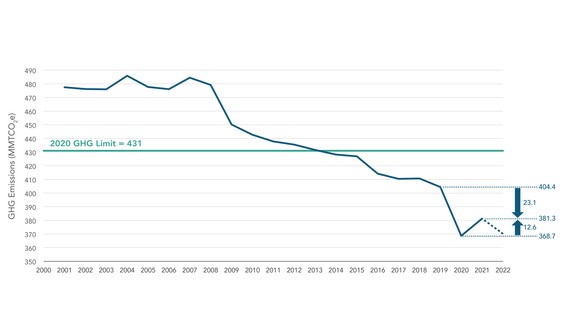
Los datos preliminares de principios de 2022 indican que la tendencia a la baja de las emisiones del estado continúa.
En comparación con 2020, las emisiones de 2021 aumentaron en casi 13 millones de toneladas métricas, lo que supone un incremento del 3 %, a pesar de que California registró un aumento del 8 % en la actividad económica tras el pico de la pandemia de COVID-19. En comparación con las cifras de 2019, anteriores a la pandemia, las emisiones han disminuido en 23 millones de toneladas métricas, lo que equivale a retirar 5 millones de turismos de las carreteras de California.
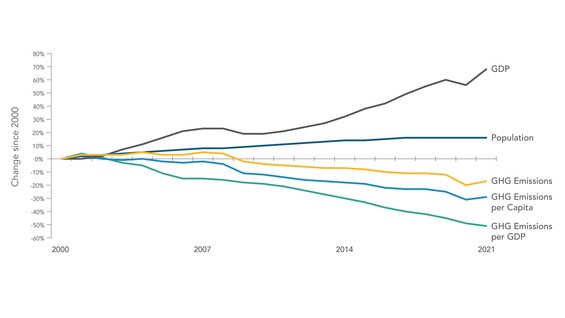
«Los datos del inventario demuestran que el compromiso de California con un enfoque global de la economía para reducir las emisiones nos está encaminando hacia un aire más limpio y un futuro más saludable», afirmó el director ejecutivo de la CARB, el Dr. Steven Cliff. «Los resultados también muestran que debemos seguir redoblando nuestros esfuerzos para hacer realidad una California neutra en carbono».
Las emisiones de 2021 disminuyeron con respecto a los datos de 2020 en los siguientes sectores:
• Las emisiones agrícolas se redujeron, gracias al uso de digestores, que eliminan el metano del aire y lo convierten en una fuente de combustible alternativa.
• Por primera vez en 20 años, las emisiones de refrigerantes se estabilizaron debido a las regulaciones de la CARB en diversos ámbitos de uso.
Las emisiones de 2021 aumentaron con respecto a los datos de 2020 en los siguientes sectores:
• Las emisiones del sector del transporte aumentaron en 10 millones de toneladas métricas, lo que refleja la vuelta a las actividades cotidianas y al trabajo tras el levantamiento de las medidas de confinamiento impuestas por la pandemia.
• Las emisiones del sector energético aumentaron en 2,8 millones de toneladas métricas, probablemente debido al incremento de la demanda y a la disminución de la energía hidroeléctrica.
• Las emisiones del sector industrial aumentaron en 0,6 millones de toneladas métricas, concretamente las procedentes de las refinerías y la extracción de petróleo, lo que también podría estar relacionado con la demanda derivada del aumento de la actividad económica.
El inventario anual de gases de efecto invernadero de California se basa en los datos del Reglamento de Notificación Obligatoria, que exige a los sectores clave que presenten datos sobre sus emisiones, así como en fuentes federales y estatales.
More information can be found on CARB's website.
HVIP FY23-24 Funding and Policy Changes
noviembre 17, 2023
On noviembre 16, 2023, the California Air Resources Board (CARB) approved the Fiscal Year (FY) 2023-24 Funding Plan for Clean Transportation Incentives, which includes policy changes and an allocation of over $400 million for school buses, drayage trucks, and small truck fleets to be administered by the Clean Truck and Bus Voucher Incentive Project (HVIP), including through Innovative Small E-Fleets (ISEF) and the Public School Bus Set-Aside.
In addition, over $500 million remains available now for new voucher requests across all vehicle types and fleets. Available funding is updated daily at www.CaliforniaHVIP.org/funding.
The Funding Plan outlines the following adopted policy changes for HVIP:
Effective noviembre 17, 2023: New Small Fleet Definition and Doubling Small Fleet Voucher Amounts
For requests placed on or after 11/17/23, small fleets are now defined as public fleets with 20 or fewer medium- and heavy-duty (MHD) vehicles or private fleets with 20 or fewer MHD vehicles and less than $15 million in annual revenue. The change in small fleet definition will apply to all uses, including eligibility for the 15% Disadvantaged Community (DAC) Plus Up, additional fund stacking flexibility with State incentive programs (e.g. Moyer, Volkswagen), and newly increased base vouchers.
The base voucher will be doubled for small public and private fleets submitting new voucher requests on or after 11/17/23 in Standard HVIP, the Drayage Truck Set-Aside, or the Public Transit Set-Aside, for any HVIP-eligible vehicles. This includes requests that would have otherwise been ISEF standard purchases. All standard purchases formerly made through ISEF will now be funded through HVIP and all existing ISEF standard purchase vouchers will be automatically adjusted to reflect the new HVIP small fleet incentive levels. No action is required by dealers and purchasers, and additional information will be forthcoming. Innovative Solutions such as short-term leases, rentals, and Truck-as-a-Service will continue to be available through ISEF.
An example calculation can be viewed in the FAQs at www.CaliforniaHVIP.org/About. The +100% base adjustment will replace the existing fleet size base adjustment of +15% which was previously in effect for private and public fleets with 10 or fewer MHD vehicles.
The criteria used to determine eligible fleet size follows the definition in the FY22-23 Implementation Manual until 1/1/24, when the fleet size definition will be updated to align with the Advanced Clean Fleets regulation, as described below.
Important note for dealers and purchasers: Updates to the online Voucher Processing Center are underway, and voucher-specific updates will be provided regarding forthcoming adjustments to vouchers to address the above policies in the coming weeks. For example, increased voucher amounts or adjustments to DAC eligibility will not be visible immediately on 11/17.
Effective Enero 1, 2024:
Updated Fleet Size definition: for Standard HVIP and all Set-Asides except for the Public School Bus Set Aside, HVIP’s fleet size definition for voucher requests placed on or after 1/1/24 will be inclusive of the fleet’s vehicles domiciled anywhere globally that are over 8,500 lbs GVWR, including all such vehicles under common ownership or control, as defined in HVIP's Implementation Manual.
Fleet size is inclusive of vehicles registered with the California Department of Motor Vehicles (DMV) as non-operational, but excluding off-road vehicles, unregistered vehicles, and those registered with the DMV as non-revivable junk or dismantled.
PO age: Starting 1/1/24, Purchase Orders or other binding sales agreements for private-entity purchasers can be dated no earlier than 90 calendar days before the date the voucher request is submitted. For public-entity purchasers, POs or other binding sales agreements can be no older than Marzo 30, 2023.
Additional limitations may apply to fleets subject to the Advanced Clean Fleet Regulation.
More information about fleet size and POs is available in the FAQs at www.CaliforniaHVIP.org/About.
Other updates:
- The existing +25% Early Adopter voucher enhancements for Refuse and Drayage, described at CaliforniaHVIP.org/funding, are extended to 12/31/24.
- Public transit fleets and fleets purchasing refuse vehicles will have an annual voucher request cap of 50 starting in 2024, in line with the existing cap for drayage purchasers. For other purchasers, the cap remains 30 vouchers per calendar year.
- The existing Manufacturer Rolling Soft Cap will continue until new Performance Review parameters are determined; a public Workgroup is anticipated in early 2024.
- Vehicle-to-Grid functionality, or bi-directional charging, will be required on all HVIP battery electric school bus vehicle eligibility applications submitted to CARB on or after 1/1/24. Applications are found in the Manufacturer Resources section at CaliforniaHVIP.org/sellers.
- Private fleets of more than 50 vehicles remain eligible to request HVIP vouchers until Enero 1, 2025, postponing by a year the policy set in the FY 2022-23 Funding Plan.
- The FY23-24 Implementation Manual is anticipated to be released in spring 2024 with more information about these changes, with mandatory Dealer Training to be announced in advance.
For more information, please contact [email protected].
CARB approves incentive funding plan that invests in equitable transition to zero-emission future
noviembre 16, 2023
CARB approves incentive funding plan that invests in equitable transition to zero-emission future
Almost $624 million investment plan directs 63% of its resources toward projects that focus on equity and target priority populations
________________________________________
SACRAMENTO – The California Air Resources Board (CARB) today approved an almost $624 million funding plan for its incentive programs that will continue to help Californians – from truck fleet operators to commuters – make the switch to zero-emission vehicles.
Under the plan, 63% of the 2023-2024 fiscal year’s investment funds will go toward bolstering equitable access, resources, and support for low-income and disadvantaged communities.
The Fiscal Year 2023-2024 Funding Plan for Clean Transportation Incentives also marks the launch of an expanded outreach process that includes surveys, meetings with community-based organizations, and the addition of monthly virtual meetings held in the evenings to increase access for Californians who have barriers to participating in the public process.
“The shift toward zero emission is only possible if every Californian has access to new and emerging vehicle technology, and our funding plan reflects the importance of equitable access in working toward a clean air future,” said CARB Chair Liane Randolph. “The funding plan also offers a wide range of tools to get Californians into cleaner options, from the trucks that transport goods across the state to e-bikes that can make it easier for residents to meet their everyday mobility needs.”
Key highlights in the funding plan include:
- Continued funding to support the launch of a statewide Clean Cars 4 All and financing assistance projects, which will provide up to $12,000 in vouchers and financing assistance to help low-income Californians replace older cars with zero-emission vehicles.
- Funding to support the new e-bike incentive project that will give up to $1,250 in vouchers to low-income Californians.
- $375 million to help public school districts purchase zero-emission buses.
- $10 million to launch a capacity-building educational effort that will give communities the tools they need to plan a clean mobility project and learn how to apply for funding resources.
- Almost $60 million to support shared mobility projects, such as car or bike-sharing, in underserved communities.
- $80 million for drayage fleet operators, as their transition toward zero-emission options begins in 2024.
- $14.3 million for a financing assistance program that targets operators and owners of small fleets.
- $14.3 million in vouchers for zero-emission off-road equipment, such as cargo-handling or construction equipment.
CARB’s incentive programs are intended to encourage the adoption of zero-emission options and have successfully supported the advancement of technology and encouraged the market to move toward cleaner options. There are now more than 100 light-duty vehicle options available for Californians to purchase, and more than 500 models available for heavy-duty vehicles and equipment. More than 1.6 million zero-emission vehicles are on Californians roads – two years ahead of schedule – and 1 out of every 4 cars sold in California is zero emission. California also recently surpassed its sales goals for zero-emission heavy-duty trucks two years ahead of schedule, before regulations officially kick in.
Ya disponible: Apéndice H del programa de reserva de plazas en el transporte público para el HVIP
31 de octubre de 2023
Ya está disponible el Apéndice H sobre la reserva para autobuses de transporte público (Apéndice H). Como complemento del Manual de aplicación del HVIP para el ejercicio fiscal 2022-2023, el Apéndice H detalla las flexibilidades concedidas a las agencias de transporte público que participan en el HVIP a través de la reserva para autobuses de transporte público (reserva para el transporte público).
Nuevas modificaciones en la reserva para el transporte público, del apéndice H, y un resumen de otras modificaciones recientes:
- Plazo de canje de 36 meses: Las empresas de transporte público disponen de 36 meses, en lugar de 18, para canjear sus vales.
- Carta de intenciones: En lugar de una orden de compra, las agencias de transporte pueden presentar una carta de intenciones (LOI) en el momento de solicitar el vale. La LOI no podrá tener una fecha anterior al 1 de enero de 2023.
- Documento de entrega: Para agilizar el proceso de canje para los distribuidores autorizados por el HVIP, se puede presentar un documento de entrega en lugar del conocimiento de embarque y antes del pago final.
- Contribución local en las solicitudes de subvenciones federales: El programa HVIP ya puede utilizarse como contribución local en los fondos del Programa Competitivo de Autobuses federal, como el Programa de Vehículos de Bajas y Cero Emisiones de la FTA.
- Modificador del 15 % para los vales: El modificador del 15 % sigue aplicándose a los vales de autobús de las empresas de transporte público.
Requisitos de elegibilidad: El programa «Transit Set-Aside» está reservado a los autobuses de transporte público adquiridos por un ayuntamiento o una administración comarcal; un distrito de transporte o un distrito de tránsito; o un organismo público. El transporte público incluye los servicios de transporte adaptado y de microtransporte gestionados por un organismo de transporte público o en su nombre. Las entidades tribales que soliciten vales para autobuses de transporte público también pueden optar a este programa.
El apéndice H y los documentos de muestra para respaldar las solicitudes de vales del programa «Transit Set-Aside» están disponibles en la página de compradores del HVIP.
Ya se ha puesto en marcha la elaboración delPlan de Financiación para el ejercicio fiscal 2023-2024 de la Junta de Recursos del Aire de California (CARB) destinado a incentivos para el transporte limpio, que incluye el programa HVIP; se publicará más información enwww.CaliforniaHVIP.orga lo largo de este año, tan pronto como esté disponible.
¡Ven a vernos!
Los equipos de EnergIIZE y HVIP estarán disponibles para mantener conversaciones en persona en la Conferencia y Exposición de Otoño de CALACT, del 1 al 2 de noviembre (stand n.º 310), y en la Conferencia y Exposición de Otoño de la CTA, del 16 al 17 de noviembre (stand n.º 706).
Si tiene alguna pregunta, póngase en contacto con [email protected].
Microgrids: Best Practices for ZEB Resiliency Report Now Available
With the adoption of zero-emission buses increasing across the United States, transit agencies are faced with real challenges for future energy management and increasingly detrimental consequences in the event of utility grid outages. CALSTART's latest report, Microgrids: Best Practices for ZEB Resiliency, addresses the utility of microgrids in the event of outages. This new report, funded by California Air Resources Board (CARB) Hybrid and Zero-Emissions Truck and Bus Voucher Incentive Project (HVIP), breaks down how microgrids not only ensure an uninterruptible power supply but will also work to offset utility costs as demand for and the cost of electricity increases in the coming decade. Take away the top five high-level factors that transit agencies must consider for microgrids on a project-by-project basis, plus examples of real-world transit microgrid projects.
Published junio 23, 2023
New Voucher Incentive Program Report Launches
As governments and industry work to accelerate the replacement of diesel engines with zero-emission technology at the pace required by science-based climate targets, the voucher incentive program (VIP) has proven to be a powerful tool to establish viability of zero-emission trucks and buses. CALSTART’s latest report Voucher Incentive Programs: A Tool for Zero-Emission Commercial Vehicle Deployment offers a deep dive into the VIP model and how it ensures faster adoption of zero-emission trucks, buses, and other commercial vehicles through direct and upfront reductions in purchase price.
HVIP is the earliest model in the United States to demonstrate the flexibility and effectiveness of point of sale incentives, and this paper outlines the basic steps in an effective VIP as well as success stories across the country that exhibit the core strengths of the VIP model: design simplicity, transparency and certainty of outcome, and flexibility/adaptability. It also highlights lessons learned and recommendations from the jurisdictions where the VIP model has been implemented, providing insights on how to make vehicle acquisition easier and more affordable and how to seamlessly integrate funding requirements to produce a simple, stable, and successful program.
Published Mayo 18, 2023
Supporting Small Fleets in the Transition to Zero Emission Trucks Report
Green For All's report primarily focuses on small fleets with a keen interest in minority-owned fleets in order to address a critical gap in both the literature and the conversation about truck electrification. Through interviews, a digital survey, and a literature review, this report set out to explore what perceptions and existing knowledge small fleets already have about ZETs, the barriers to electrification they anticipate, the solutions they find promising, and the best processes to intentionally engage them in shaping ZET policies and programs. The findings and recommendations are based on this initial research and offer learnings that can help inform forthcoming programs and policies.
To read the full report, visit Dream.org's website.
Published Febrero 20, 2023
Follow the funds! Voucher data updated monthly
Follow the Funds! Voucher data and map are updated monthly. Learn where HVIP-funded vehicles are benefiting California, including voucher requests and vehicles already deployed.
Visit https://californiahvip.org/impact/#deployed-vehicle-mapping-tool to learn more.
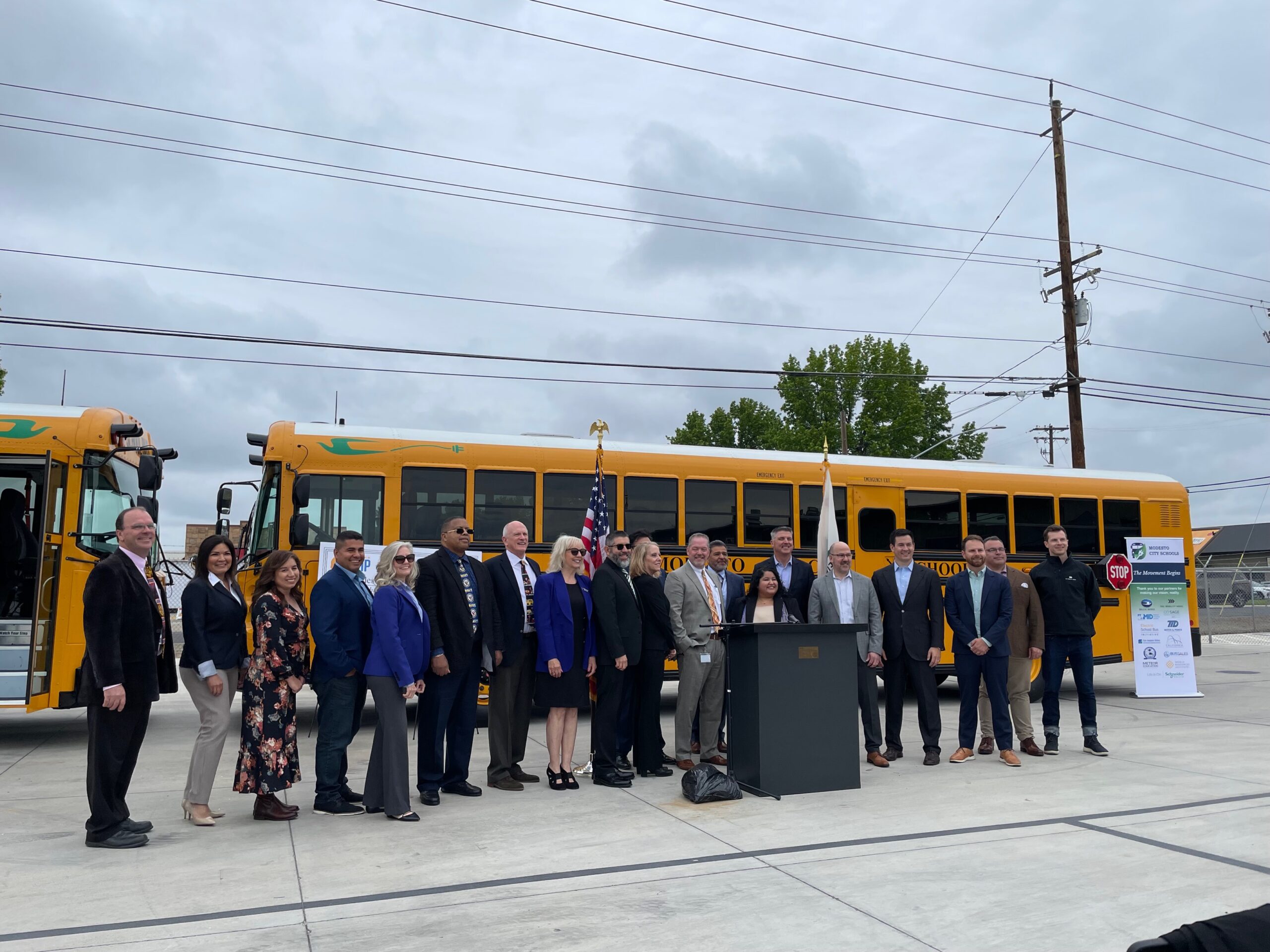
Las escuelas de la ciudad de Modesto recibirán 30 autobuses escolares eléctricos (20 de abril de 2022)
El martes 19 de abril de 2022, las Escuelas de la Ciudad de Modesto celebraron la adquisición de 30 autobuses escolares eléctricos. Esta adquisición ha sido posible gracias a la financiación del programa HVIP.
HVIP Public School Bus Set-Aside for Small and Medium Air Districts
$130 Million Set-Aside for Eligible School Buses
The California Air Resources Board (CARB) approved a $130 million set-aside intended to cover nearly, if not all, of the full cost of new zero-emission school buses for public school districts and other qualifying entities located in small-sized air districts and in medium-sized air districts.
Public School Bus Set-Aside Flyer
Applications for the Public School Bus Set-Aside for Small and Medium Air Districts (Public School Bus Set-Aside) will be accepted when HVIP opens, which is anticipated for late Marzo. More information will be provided to all stakeholders and posted to www.CaliforniaHVIP.org and www.CaliforniaHVIP.org/Purchasers when the HVIP Implementation Manual for FY21-22 funds is published, before HVIP opens.
Mark Your Calendar – Marzo 2nd Working Group
Join us 11am-12pm (PT) on Wed., Marzo 2nd for a working group meeting on the available and upcoming funding opportunities for electric school buses (ESBs), including the HVIP Public School Bus Set-Aside for Small and Medium Air Districts. The Marzo 2nd working group is a part of a series of monthly California Electric School Bus Working Group Meetings, convened by CALSTART, please spread the word!
Purchaser Eligibility for Set-Aside Funds
Eligible applicants in small and medium air districts should apply when HVIP opens. For the first 90 days, funding will be prioritized for applicants that are in a small air district AND are also in a Disadvantaged Community. After the initial 90 days, requests are first come first served for all qualifying purchasers in all small and medium-sized air districts.
At the time of their initial funding request, applicants will need to identify bus(es) to scrap / retire, but do not need to know yet what bus(es) they potentially want to purchase. HVIP staff will connect applicants with an HVIP Approved Dealer who will complete the rest of the application on their behalf.
Before HVIP opens, school buses eligible for the set-aside funds will be indicated on the HVIP Eligible Vehicle Catalog. See the flyer for details about the old bus scrappage requirement.
All applicants must serve students at the K-12th grade level. Eligible applicants include:
- CA Public School Districts or Public Charter Schools
- CA Joint Power Authorities (JPAs)
- CA County Offices of Education (COEs)
- Division of State Special Schools of the CA Department of Education
Details of this set-aside are subject to change until the HVIP FY21-22 Implementation Manual is published.
Outreach is underway now! Please reach out to [email protected] with any questions or to subscribe to Public School Bus Set-Aside updates. We’re here to help.
Posted 2/17/2022
Zeroing in on ZETs Report Available (2/4/2022)
Zeroing in on Zero-Emission Trucks is an inventory of Class 2b-8 zero-emission trucks (ZETs) in the U.S. as of Diciembre 2021. The report provides insight on ZET market trends as the industry prepares for an injection of federal funding for charging infrastructure, multiple states implement clean truck regulations, and California prepares to release an additional $873 million in purchase incentives for commercial vehicles and infrastructure.
The report found that 738 ZETs are deployed in California. Of those, 448 are funded by HVIP.
The report is now available online.
Zeroing in on ESBs Report Available (1/19/2022)
The latest in the Zeroing in on series, CALSTART has released Zeroing in on ESBs, an inventory of electric school buses (ESBs) in the U.S. As of Septiembre 2021, there are 1,738 ESBs funded, ordered, delivered, and deployed across the U.S. You can also see which states have the most ESBs by state and by EPA region.

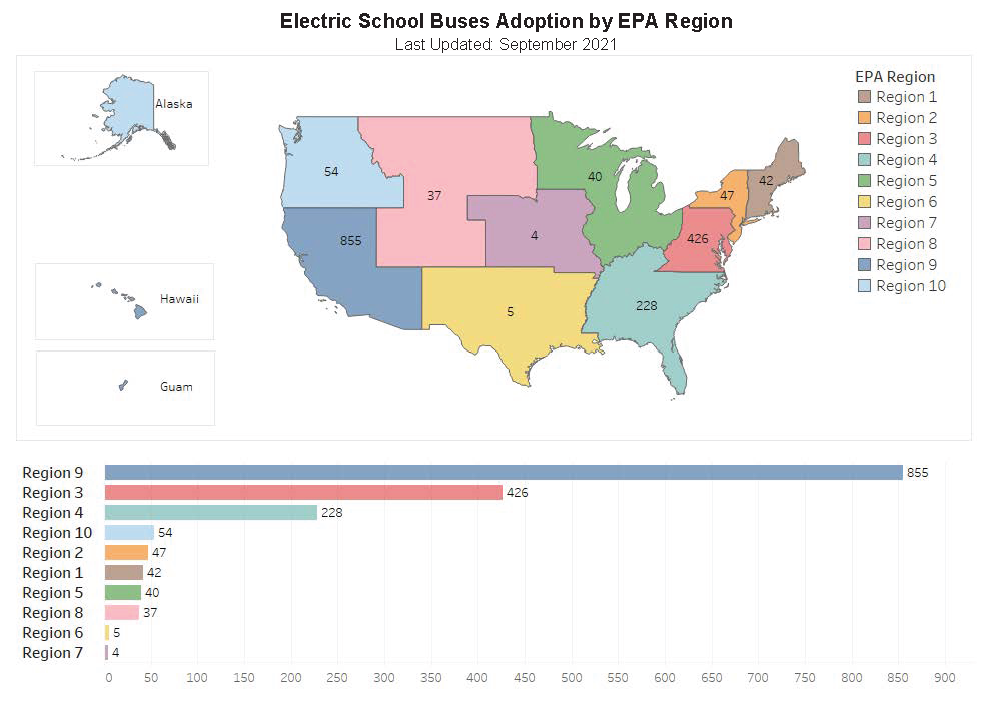
More information can be found in the report's press release.
Incentives for Commercial Zero Emission Vehicle Infrastructure
Posted 1/13/2022
Ya está disponible el informe «Zeroing in on ZEBs» (11/1/2022)
CALSTART's annual inventory of zero-emission buses (ZEBs), “Zeroing in on ZEBs”, has just been released. The report provides insight on the current state of ZEBs ahead of $5.25 billion in Infrastructure Investment and Jobs Act funding through the Federal Transit Administration’s Low-No Program. Great news found in the report is that full-size ZEBs have grown to 3,533 buses nationally, an increase of 27% since the 2020 count.
California sigue liderando la implantación de autobuses ZEB de tamaño normal, mientras que Nueva York y Washington completan la clasificación en cuanto a cifras totales por estado. El informe de este año también incluye un desglose de autobuses de tamaño normal y pequeños, ya que la implantación de autobuses ZEB pequeños aumentó un 51 %.
More information can be found in the report's press release.
Publicado el 11 de enero de 2022
HVIP Wave 3 Summary and Waitlist (11/15/2021)
HVIP Wave 3 Funding Summary and Waitlist
noviembre 15, 2021
HVIP opened to new voucher requests at 10 a.m. Jueves, Octubre 28, and all available funds, $63 million, were requested within 9 minutes. This was the third and final wave of funding for 2021.
Although HVIP remains temporarily closed to most new voucher requests until more funds, additional funding will be available in 2022. In the meantime, HVIP will continue to support voucher requests for Class 8 zero-emission tractors performing drayage operations NOW with a drayage waitlist, in order to help advance this key zero-emission market segment.
A waitlist is now open for dealers/manufacturers who sell HVIP-eligible class 8 tractors performing drayage operations, that are currently on the HVIP-eligible vehicles list as Drayage Capable. Dealers/manufacturers must be currently on the HVIP-eligible dealer list at californiahvip.org/dealerlist. Drayage dealers/manufacturers received additional instructions via email earlier today about how to participate; if you are a drayage dealer/manufacturer who currently participates in HVIP and have not received instructions, please reach out to [email protected].
This waitlist also currently includes ANY eligible voucher requests that were submitted after funding was fully requested during the wave 3 opening on Octubre 28, but BEFORE HVIP closed later that same morning. Dealers can determine whether their vouchers are on the waitlist if the “Waitlist” checkbox in the Voucher Details tab of the online Voucher Processing Center is checked on those vouchers. Voucher requests without the checkbox checked are unfunded, based on timestamp. Affected dealers have already been notified. Please contact [email protected] for information about the status of specific vouchers.
The CARB Board will consider the FY21-22 Funding Plan for Clean Transportation Investments, including funding for HVIP, at the Viernes, noviembre 19 Board meeting. The Funding Plan includes historic levels of funding for zero-emission technologies. More information about 2022 funding will be announced when available from CARB.
HVIP Opens on Octubre 28 to New Voucher Requests
The Hybrid and Zero-Emission Truck and Bus Voucher Incentive Project (HVIP) will open to new voucher requests at 10 a.m. Pacific on Jueves, Octubre 28, 2021, with its wave 3 of funding (approximately $62 million) on a first-come, first-served basis.
HVIP opened to new voucher requests on junio 8 (wave 1) and Agosto 10 (wave 2) with its FY 20-21 funding and those funding allocations have been fully requested.
Purchase Orders for Voucher Requests
A valid signed Purchase Order (or other binding Agreement, Contract, Buyer’s Order, or action/resolution by a government entity’s governing body) is required at the time a voucher request is made. Non-binding agreements are not sufficient to reserve a voucher. A purchase order or other sales agreement that was eligible at the time of the initial opening in junio will remain eligible throughout the project year, including wave 3.
- POs for private-entity purchasers can be no older than Mayo 29, 2021
- POs for public-entity purchasers can be no older than Marzo 10, 2021
Dealer Training
Any dealers planning to request vouchers for wave 3 who have questions about their VPC login credentials or other concerns should contact [email protected] immediately to ensure their seamless participation. Dealers who are interested in participating in wave 3 must contact us by Octubre 18th in order to be trained and approved on time to participate in wave 3. All dealer training requirements must be completed by Octubre 25th in order to get access to the online Voucher Processing Center in advance of the release of the third wave of funds this fall.
If you have questions about the status of specific vouchers, please contact [email protected].
Guidance for Purchasers
Posted 10/14/2021
CCI Reports Implementation of $9 Billion in Projects to Reduce GHG
Agosto 24, 2021
California Climate Investments Reports Implementation of $9 Billion in Projects to Reduce Greenhouse Gases
California officials say clean vehicle purchases and new projects that have come online since Diciembre 2020 will eliminate 11,000 tons of air pollutants and toxics from California’s air. The California Air Resources Board administers the California Climate Investments program, funded with proceeds from the State’s Cap-and-Trade GHG emissions reduction program.
Since 2013, the Legislature has appropriated $15.4 billion in California Climate Investments funds for projects statewide, $9 billion of which are either underway or completed. Approximately $4.5 billion of all implemented funds directly benefit California’s priority populations, which include disadvantaged and low-income communities and low-income households statewide. California Climate Investments will provide about 70 million metric tons of GHG emissions reductions, the equivalent of taking 14 million cars off the road for a year. This does not include expected GHG emissions reductions attributable to the High-Speed Rail project.
More than 20 state agencies manage investments in over 70 programs. New investments since Diciembre 2020 total 53,800 projects and will reduce greenhouse gas (GHG) emissions and promote a healthier California through these projects, including 51,000 rebates for the purchase of zero-emission vehicles and 697 affordable housing units.
More information can be found in the eblast and on CCI's website.